5 min read
Fall HVAC Troubleshooting: Why Your Heater Smells Like Burning Dust on Startup
Is that burning dust smell normal? Read our home maintenance tips and troubleshooting to see why heating startup odors happen and when to call a professional.


As summer heat fades, your AC runs less often—leaving high humidity trapped indoors. Discover why your thermostat reads 72°F but the air still feels thick and sticky, and how to fix it.
The transition into early fall brings a welcome break from peak summer temperatures, but explaining the difference between sensible and latent heat when your house feels clammy in September is exactly what our technicians at TemperaturePro Baton Rouge find themselves doing for homeowners across the Gulf Coast. The outdoor thermometer finally dips below ninety degrees, yet the air inside your living room feels thick, sticky, and uncomfortable. You check the wall, and the thermostat reads 72°F but indoor humidity remains above 60%. This physical discomfort happens because the temperature of the air and the moisture trapped inside that air are handled differently by your cooling system.
If you want to improve your home's overall Indoor Air Quality, understanding this specific seasonal challenge is the first critical step.
Living along the Gulf Coast means dealing with a unique climate pattern as summer fades. During the peak of July, your cooling system runs constantly to battle the intense outdoor heat. That long, continuous operation naturally pulls a massive amount of moisture out of your indoor air. However, the September transition brings a distinct change. The ambient outdoor temperatures begin to drop, often hovering in the upper seventies or low eighties during the evening. While the heat backs off, the deep, heavy humidity rolling off the Gulf does not.
When our team is out performing pre-heating-season tune-ups in neighborhoods across Baton Rouge, we consistently see how this creates a mechanical mismatch inside your home. Your cooling equipment is designed to lower the temperature, but it relies on long run cycles to extract moisture. When the house cools down too quickly on a mild fall day, the system shuts off before it has a chance to wring the water out of the air. The result is a home that feels cold but damp, leaving your skin feeling clammy and making the indoor environment feel far less comfortable than the thermostat suggests.
To understand why your home feels so uncomfortable, you first have to understand how heat is measured. Sensible heat is the thermal energy that causes a direct, measurable change in the temperature of a substance without changing its physical state. In simple terms, this is the heat you can actually feel on your skin, and it is the exact metric that a standard thermometer measures.
When you turn on a space heater, open an oven door, or let the afternoon sun beat through a living room window, you are adding sensible heat to the room. The air molecules move faster, the room gets warmer, and the temperature reading goes up. When your air conditioner kicks on to combat this, it absorbs that thermal energy and carries it outside. As the system removes sensible heat, the indoor air simply gets cooler.
As local HVAC professionals, we often remind our customers that your thermostat is essentially a sensible heat gauge. It is programmed to monitor the ambient temperature of the room and send a signal to your cooling equipment when that temperature rises above your setpoint.
• Targeted response: If you set the dial to 72°F, the system will run until the sensible heat is removed and the air reaches that exact temperature.
• Blind spot: A standard thermostat does not factor in moisture levels when deciding when to turn the cooling cycle off.
• Quick satisfaction: On mild days, the sensible heat target is reached very rapidly, causing the system to shut down prematurely.
Because the thermostat only cares about sensible heat, it believes its job is completely finished the moment the room hits 72°F. It sends the shut-off signal, leaving the blower motor and compressor idle, even if the air still feels incredibly heavy and uncomfortable to the people living inside.
While sensible heat changes the temperature, latent heat is the energy required to change the physical state of a substance without altering its temperature. In the context of residential cooling, latent heat is all about the energy trapped inside airborne water vapor. When water evaporates into the air, it absorbs a massive amount of heat energy. This energy remains hidden within the humidity, which is why high humidity makes the air feel so heavy and oppressive.
When we talk about latent heat removal in the HVAC industry, we are talking about dehumidification. For a cooling system to remove this hidden energy, it has to pull warm, moist air across a freezing cold evaporator coil. As the air touches the cold metal, the water vapor undergoes a phase change, condensing from a gas back into a liquid. This condensation drips into a drain pan and is carried out of your home.
The core problem during the early fall is that latent heat is completely invisible to a standard wall thermostat. You can have a situation where the thermostat reads 72°F but indoor humidity remains above 60%, and the system will not turn on because the sensible heat requirement has been met. The latent heat energy remains suspended in the air, making your skin feel sticky and preventing your sweat from evaporating naturally.
Managing this hidden moisture requires a different approach than simply managing the temperature. For more strategies on tackling this specific issue, reviewing these AC and humidity control tips for Gulf Coast homes can help you understand the broader impact of airborne moisture on your daily comfort.
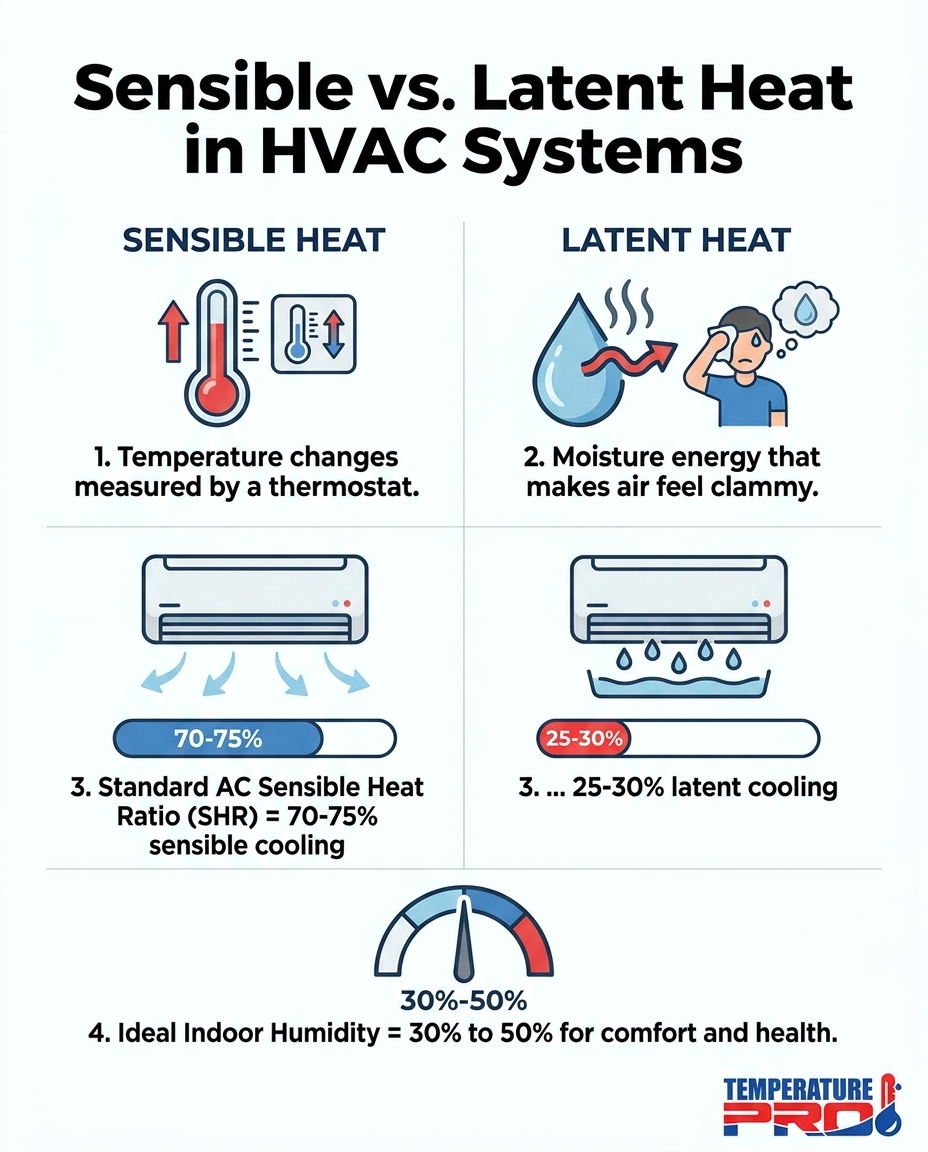
To fully grasp why the September transition causes such profound comfort issues, you have to look at how cooling equipment is manufactured. Every cooling unit operates based on a metric called the Sensible Heat Ratio (SHR). This ratio dictates how the machine divides its total cooling capacity between dropping the temperature (sensible cooling) and removing moisture (latent cooling).
Most standard residential systems are designed with an SHR of around 0.70 to 0.75. This means that 70 to 75 percent of the system's effort is dedicated purely to lowering the air temperature, while only 25 to 30 percent of its effort is dedicated to extracting moisture from the air.
Because standard equipment only dedicates a small fraction of its power to latent heat removal, the system requires long, uninterrupted run cycles to effectively dehumidify a house. The evaporator coil has to get cold, stay cold, and have enough warm air pass over it to allow significant condensation to form and drip away.
• Peak Summer (August) — Sensible Load (Heat): High — Latent Load (Humidity): High — System Run Time: Long, continuous cycles — Resulting Comfort: Cool and dry
• Early Fall (September) — Sensible Load (Heat): Low — Latent Load (Humidity): High — System Run Time: Short, brief cycles — Resulting Comfort: Cold and clammy
During the early fall in Baton Rouge, our service techs see this mechanical limitation become glaringly obvious. The sensible cooling load drops drastically because the outdoor temperature is milder. However, the latent cooling load remains extremely high due to the persistent Gulf Coast humidity. The system kicks on, blasts cold air, and satisfies the sensible heat setpoint in just ten or fifteen minutes. It shuts off long before the coil has had time to condense and drain the heavy moisture, leaving the latent heat trapped inside your living spaces.
When a home feels sticky and uncomfortable, the most common reflex we hear about from our Baton Rouge customers is walking over to the hallway and bumping the thermostat down a few degrees. If the house feels miserable at 74°F, homeowners will drop it to 68°F in an attempt to force the system to run longer. While this does force the equipment to cycle back on, it creates a completely new set of problems.
First, it leads to the dreaded "meat locker" effect. By pushing the system past its intended sensible heat setpoint, you are overcooling the environment. The air becomes freezing cold, but because the system is still operating on that 75/25 Sensible Heat Ratio, it is still struggling to pull out enough moisture. You end up sitting in a room that is simultaneously freezing and damp, which is often more uncomfortable than a warm room.
Using a standard cooling unit as a dedicated dehumidifier is incredibly inefficient. Forcing the equipment to run longer by artificially lowering the temperature wastes a massive amount of electrical energy. You are paying to cool the air to an uncomfortably low temperature just to wring out a few extra drops of water.
It is important to remember that a standard unit is not a dehumidifier. It is a temperature control device that happens to remove some moisture as a byproduct of the cooling process. When the thermostat reads 72°F but indoor humidity remains above 60%, fighting the physics of the machine by dropping the temperature setting to 68°F will only result in higher utility usage and a shivering household.
When persistent humidity issues plague a home during the September transition, guessing at the solution usually leads to frustration. Fixing a clammy home requires a scientific approach to diagnose the underlying physics of the airflow, the condition of the evaporator coil, and the overall sizing of the equipment.
At TemperaturePro Baton Rouge, a pattern we see often involves oversized equipment. If a cooling unit is too large for the square footage of the house, it will inherently short-cycle. It blasts a massive volume of cold air, dropping the temperature in minutes, and shutting off before any latent heat removal can occur. An oversized system might keep you freezing cold in July, but it will leave you miserable and sticky in September.
Because TemperaturePro Baton Rouge is a veteran-owned company, you get the same level of discipline and accountability that military service demands, especially when it comes to honest diagnostics. We focus on educating the homeowner on the true science of their comfort issues rather than pushing an immediate, unnecessary sale.
For example, a local Baton Rouge homeowner recently reached out to us when their AC unit was not cooling properly; our crew serviced the equipment promptly, diagnosing a severe airflow restriction over the coil rather than just blindly adding refrigerant. By taking the time to measure static pressure, evaluate the blower motor speed, and check the cleanliness of the evaporator coil, a professional assessment can determine exactly why your system is failing to capture latent heat. Sometimes the fix is as simple as adjusting the blower speed to allow the air to spend more time crossing the cold coil, increasing the moisture extraction rate.
If our technicians verify your cooling system is sized correctly and running properly but you still struggle with the September transition, here is what we recommend to our customers to manage latent heat independently of your sensible cooling load. Taking control of your indoor humidity requires separating the two types of heat.
1. Install a whole-home dehumidifier: This is the ultimate solution for managing latent heat. A dedicated whole-home dehumidifier ties directly into your existing ductwork. It operates entirely independently of your cooling cycle. When the thermostat is satisfied and the main cooling unit shuts off, the dehumidifier can continue to run, pulling moisture out of the air without dropping the temperature any further. This allows you to keep the thermostat at a comfortable 74°F while maintaining a crisp, dry 45% relative humidity. (Note: generic utility incentive programs or tax credits may apply to qualifying high-efficiency dehumidification or HVAC upgrades, so we always advise checking with your local utility provider.)
2. Optimize your thermostat fan settings: One of the most common mistakes we see homeowners make is switching their thermostat fan setting from "Auto" to "On." When the fan is set to "On," the blower motor runs constantly, even when the outdoor compressor is off. This takes the moisture that just condensed on your evaporator coil and blows it right back into your living room before it has a chance to drain away. Always keep the fan set to "Auto" during the cooling season to prevent moisture re-evaporation.
3. Keep up with routine coil maintenance: An evaporator coil can only extract moisture if the air can actually touch the cold metal fins. If the coil is packed with dust, pet hair, and debris, it acts as an insulating blanket. The sensible cooling capacity drops, and the latent cooling capacity plummets. Staying enrolled in our AC Maintenance Plan ensures that your coils remain clean, allowing the physics of condensation to work exactly as engineered.
By addressing latent heat directly, you can eliminate the heavy, clammy feeling that plagues so many Gulf Coast homes during the early fall, ensuring your indoor air feels as comfortable as the temperature reading suggests.
Why does my house feel clammy at 72 degrees?
Your house feels clammy at 72 degrees because your cooling system has satisfied the sensible heat (temperature) requirement but failed to run long enough to remove the latent heat (humidity). When indoor humidity rises above 60 percent, the air feels heavy and sticky, preventing natural sweat evaporation. This often happens on milder days when the system short-cycles.
What is the difference between sensible and latent cooling?
Sensible cooling reduces the actual temperature of the air, which is the metric measured by your wall thermostat. Latent cooling removes the hidden energy trapped in airborne moisture by condensing water vapor into a liquid. A standard cooling system performs both functions simultaneously, but dedicates most of its effort to sensible cooling.
How do I get rid of latent heat in my house?
The most effective way to remove latent heat is to use a dedicated whole-home dehumidifier that operates independently of your temperature settings. You should also ensure your thermostat fan is set to "Auto" rather than "On" to prevent moisture from blowing back into the house. Keeping your evaporator coils clean also maximizes the system's natural dehumidification ability.
Does my AC remove sensible or latent heat?
Your system removes both, but it is heavily biased toward sensible heat. Standard residential equipment operates on a Sensible Heat Ratio (SHR) that dedicates about 70 to 75 percent of its capacity to lowering the temperature, and only 25 to 30 percent to removing moisture. This is why it struggles to dehumidify during mild weather.
Why is indoor humidity worse in September and early fall?
Indoor humidity spikes in early fall because outdoor temperatures drop while ambient humidity remains high. Because the sensible heat load is lower, your cooling system reaches its target temperature very quickly and shuts off. These short run times prevent the system from operating long enough to wring the heavy moisture out of the indoor air.
Can a dirty AC coil affect humidity removal?
Yes, a dirty evaporator coil severely restricts a system's ability to remove humidity. Dust and debris act as an insulating barrier, preventing the warm, moist indoor air from making direct contact with the freezing metal fins. Without that direct thermal transfer, condensation cannot form efficiently, leaving the latent heat trapped inside your home.
Dealing with a home that feels sticky and damp despite a normal thermostat reading can be incredibly frustrating. By understanding the science behind sensible and latent heat, you can stop fighting your thermostat and start addressing the true source of the problem. If you are tired of the early fall comfort trap and want a clear, actionable path forward, exploring professional Air Conditioning Services with our team can help you implement the right moisture control solutions for your specific climate.
Go With Experience