Sizing Commercial HVAC Rooftop Units for Baton Rouge Strip Malls Facing Western Sun
Sizing Commercial HVAC Rooftop Units for Baton Rouge Strip Malls Facing Western Sun
When the late-summer August sun turns your retail space into an oven, standard RTU calculations fail. Find out how solar heat gain impacts commercial cooling loads.
When the August Afternoon Sun Turns Your Retail Space Into an Oven
If your retail store feels like a sauna by 4:00 PM, you already know the unique challenge of sizing commercial HVAC rooftop units for Baton Rouge strip malls facing western sun. Your thermostat is set to 72 degrees, the blower is running at full capacity, and cold air is pouring out of the vents. Yet, the front half of your store is uncomfortably hot, your employees are sweating, and customers are cutting their visits short. This is a common pattern across South Louisiana retail spaces. The problem usually is not a broken air conditioner, but rather a fundamental flaw in how the system was originally sized for the building's orientation.
For property managers dealing with this exact issue, finding the right air conditioning systems requires specialized commercial HVAC sizing and installation that accounts for our extreme local weather. The intense August late-summer afternoon glare hitting a glass storefront creates a massive thermal load that generic sizing methods simply cannot handle. A standard calculation assumes uniform heat distribution throughout the day, but a west-facing retail space experiences a sudden, severe spike in temperature right as the business day peaks. Addressing this requires stepping away from basic estimates and understanding the specific physics of how solar energy interacts with your building.
The Unique Physics of Glass Storefront Solar Heat Gain
To understand why your store gets so hot in the late afternoon, we have to look at how solar radiation travels. When sunlight hits a solid brick or concrete wall, the material absorbs the heat slowly. It takes hours for that thermal energy to transfer through the insulation and reach the indoor air. Glass behaves entirely differently. Unshaded commercial windows allow solar radiation to pass directly into the building, instantly heating the floors, display cases, and indoor air. This rapid temperature transfer is known as glass storefront solar heat gain.
The Low-Angle Sunlight Problem
Baton Rouge's intense late-summer heat amplifies the solar radiation hitting unshaded glass, creating a compounded thermal load. At noon, the sun is directly overhead. Most commercial buildings have roof overhangs, awnings, or parapets that cast a shadow over the windows during the middle of the day. However, as the afternoon progresses, the sun drops lower in the western sky. By 4:00 PM, the sun's rays are coming in at a low, horizontal angle. This low-angle sunlight completely bypasses roof overhangs and blasts directly through the storefront glass.
Key factors driving this thermal load include:
• Direct Radiation: Sunlight physically entering the space and warming solid objects inside the store.
• Conduction: The glass panes themselves heating up and transferring that heat to the indoor air.
• Infiltration: Hot outdoor air pushing through poorly sealed front entry doors as customers come and go.
This specific orientation drastically alters the baseline cooling requirement. A west-facing boutique requires significantly more cooling capacity during the late afternoon than an identical, windowless retail space right next door.
Why 'Rule of Thumb' Square-Footage Sizing Fails in South Louisiana
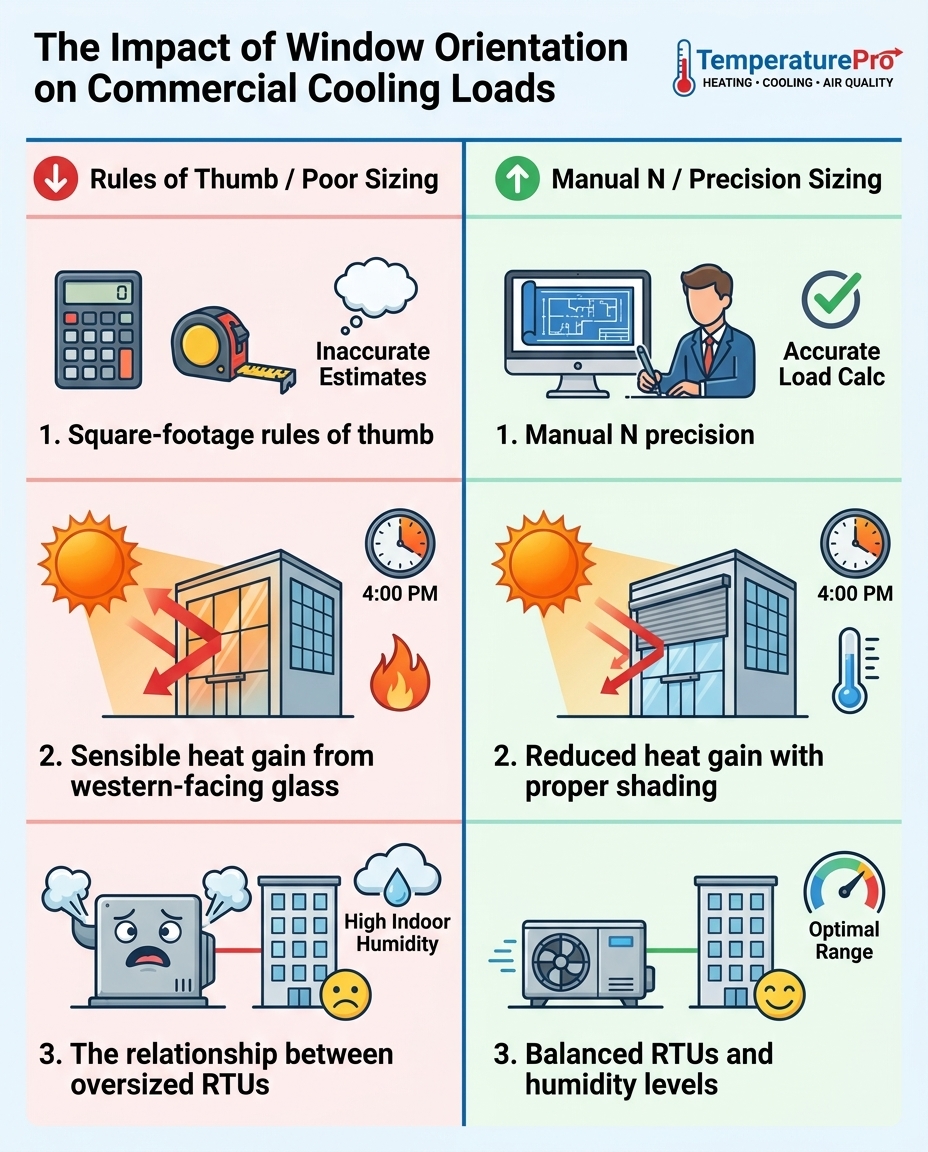
The problem: Historically, many contractors have relied on a simple mathematical shortcut to determine how much cooling a commercial space needs. The most common rule of thumb dictates installing one ton of cooling capacity for every 400 square feet of floor space. If you have a 2,000-square-foot store, this generic formula suggests a 5-ton rooftop unit (RTU). This method is fast, easy, and completely ignores the reality of the building's architecture.
The cause: These rules of thumb originated decades ago for generic, box-like commercial spaces. They completely ignore building orientation, roof color, insulation quality, and, most importantly, window-to-wall ratios. A 2,000-square-foot store facing north with small windows has a fraction of the heat load of a 2,000-square-foot store facing west with floor-to-ceiling glass. Relying on generic metrics guarantees an undersized unit during peak afternoon hours for Baton Rouge strip malls.
The solution: As a local HVAC authority, we abandon lazy rules of thumb in favor of precise, orientation-specific load calculations. We look at the actual physics of the building rather than just measuring the floor plan.
• Square-Footage Rule of Thumb — Data Used: Floor area only — Handling of Western Sun: Completely ignored — Typical Outcome in Retail: Hot storefronts, sweating customers at 4 PM
• Custom Load Calculation — Data Used: Orientation, glass type, insulation, occupancy — Handling of Western Sun: Calculated down to the specific hour of peak load — Typical Outcome in Retail: Consistent temperatures throughout the business day
The Impact of Window Orientation on Commercial Cooling Loads
The Danger of Oversizing: Balancing Sensible Cooling and Humidity Control
When a property manager realizes their west-facing store is too hot in the afternoon, the instinctive reaction is to simply install a massive, oversized rooftop unit. If a 5-ton unit cannot keep up with the August late-summer afternoon glare, a 7.5-ton unit should fix the problem, right? Unfortunately, this creates an entirely new and potentially worse problem: a total loss of humidity control.
Sensible Cooling vs. Latent Cooling
Air conditioning systems perform two distinct jobs. Sensible cooling is the process of lowering the actual temperature of the air (dropping it from 80 degrees to 72 degrees). Latent cooling is the process of removing moisture from the air (dropping the humidity from 70% to 45%). Baton Rouge is located in ASHRAE Climate Zone 2A, which is classified as Hot/Humid. In this region, latent cooling is just as critical as sensible cooling.
The Short-Cycling Trap
Baton Rouge's extreme late-summer humidity requires a delicate balance; the AC must run long enough to dehumidify, which is impossible if the unit is massively oversized just to fight the 4 PM sun. When an oversized unit turns on during a mild morning, it blasts the space with cold air. The thermostat registers 72 degrees within ten minutes and shuts the system off. Because the unit only ran for ten minutes, it never had time to pull the moisture out of the air. This phenomenon is called short-cycling.
The result is a retail store that feels cold but clammy. Condensation might form on the windows, paper products can feel damp, and the indoor air feels heavy. If you are choosing an AC for Louisiana heat and humidity, you must size the equipment to run in long, steady cycles that extract moisture, rather than short bursts that only drop the temperature.
Using ACCA Manual N for Precise Commercial Load Calculations
To solve the dual threat of undersized afternoon cooling and oversized morning humidity, the commercial HVAC industry relies on a strict mathematical standard. The Air Conditioning Contractors of America (ACCA) developed Manual N as the recognized national standard for commercial load calculations. This protocol eliminates guesswork and replaces it with hard data.
The Manual N calculation requires several specific inputs:
• Solar Heat Gain Coefficient (SHGC): A measurement of how much solar radiation passes through the specific type of glass installed in the storefront.
• Building Orientation: The exact compass direction the windows face, allowing the calculation to predict heat loads at different times of the day.
• Internal Heat Loads: Heat generated by lighting, display coolers, computers, and the average number of customers inside the store.
• Envelope Insulation: The R-value of the roof and walls surrounding the retail space.
Custom load calculations are the only way to prevent the dual threat of undersized afternoon cooling and oversized morning humidity. By running a Manual N calculation specifically for glass storefront solar heat gain, a professional contractor can determine the exact peak load at 4:00 PM. They can then specify equipment—often utilizing multi-stage compressors or variable-speed blowers—that can ramp up to fight the afternoon sun, while running at a lower capacity in the morning to steadily remove humidity.
Protecting Inventory and Customer Comfort in Retail Environments
Accurate HVAC sizing is not just an engineering exercise; it has a direct impact on your bottom line. Retail environments in Baton Rouge strip malls carry sensitive inventory that reacts poorly to severe temperature swings. Boutiques selling cosmetics, pharmacies storing medications, and specialty food shops selling chocolates all require strict climate control. When a west-facing storefront spikes to 85 degrees in the late afternoon, inventory can degrade or melt, leading to direct financial losses.
The Psychology of Thermal Comfort
Beyond inventory, thermal comfort directly influences customer dwell time and purchasing behavior. When a customer walks out of the sweltering Louisiana heat and into a retail store, they expect immediate relief. If the front of the store is hot and stuffy, the customer's natural instinct is to leave quickly. Studies consistently show that shoppers spend more time browsing—and ultimately spend more money—in environments with stable, comfortable temperatures and controlled humidity.
Eliminating Retail Hot Spots
Another major challenge in west-facing stores is temperature stratification. If the system is poorly designed, the front ten feet of the store near the glass becomes an oven, while the windowless back of the store becomes a freezer. Proper load calculations dictate not just the size of the rooftop unit, but also the ductwork design and air balancing required to push enough cold air to the front windows without freezing the employees working in the back stockroom.
Maintaining Peak Afternoon Performance for Your Rooftop Unit
Even if your commercial rooftop unit is sized perfectly using a Manual N calculation, it will still fail to keep up with the August late-summer afternoon glare if it is suffocating from a lack of maintenance. Commercial HVAC systems operating in harsh Southern climates endure massive stress, and a neglected unit loses its cooling capacity very quickly.
The quick fix: Keep the condenser coils clean. The rooftop unit cools your building by absorbing indoor heat and releasing it outside through the condenser coils. If those coils are caked in dirt, pollen, exhaust soot, or debris, the heat transfer process slows down dramatically. A dirty condenser coil drastically reduces sensible cooling capacity right when the afternoon sun hits its peak.
Proper airflow across the indoor evaporator coil is equally important for effective dehumidification. If air filters are clogged, the blower motor cannot pull enough air across the cold coil. This leads to poor moisture removal and can even cause the coil to freeze solid, shutting down your cooling entirely in the middle of the business day. We strongly recommend proactive system checks prior to the late-summer peak. Scheduling routine commercial HVAC maintenance ensures the RTU can handle the maximum thermal load when the western sun is at its worst.
Get an Accurate Commercial HVAC Load Assessment Today
Understanding local solar and humidity factors is the key to proper commercial HVAC sizing. If your retail space struggles to stay cool in the late afternoon, the solution is not to blindly install a larger unit. Doing so will only trade a heat problem for a severe humidity problem. Precise engineering is required to balance the intense sensible heat of the afternoon sun with the latent cooling demands of South Louisiana mornings.
We strongly reiterate the value of professional Manual N assessments over guesswork and outdated rules of thumb. The unique architecture of Baton Rouge strip malls demands a custom approach to climate control. Reach out to a local expert today to evaluate your retail space's specific cooling needs, calculate your true thermal load, and design a system that keeps your store comfortable from opening until closing time.
Frequently Asked Questions
How do you calculate cooling load for a commercial building?
A professional calculates the cooling load using the ACCA Manual N protocol. This mathematical formula measures the building's square footage, insulation values, window orientation, heat generated by occupants, and local climate data. It is the only reliable way to ensure the HVAC system is sized perfectly for the specific space without relying on inaccurate rules of thumb.
Does sun exposure affect AC size?
Yes, sun exposure is one of the largest factors in determining AC size. A building facing west with large glass windows absorbs massive amounts of solar radiation in the late afternoon. This space will require significantly more cooling capacity than an identical building facing north or a building heavily shaded by trees and awnings.
Why is my commercial AC not cooling in the afternoon?
If your AC cools fine in the morning but struggles in the afternoon, it is likely undersized for the peak solar load. As the sun lowers in the western sky, it pushes intense heat through storefront windows, overwhelming a system that was only sized for average daily temperatures. Dirty condenser coils or clogged filters can also cause the system to fail under peak stress.
How many tons of AC do I need for a commercial storefront?
There is no standard answer, as tonnage depends entirely on the building's specific characteristics. While old rules of thumb suggest one ton per 400 square feet, a glass-heavy storefront facing west may require much more capacity. Only a formal Manual N load calculation can accurately determine the exact tonnage needed for your specific retail space.
Can commercial window tinting reduce my HVAC cooling load?
Yes, applying a high-quality commercial window film can significantly reduce your cooling load. Tinting lowers the Solar Heat Gain Coefficient (SHGC) of the glass, reflecting a large portion of the sun's radiation before it enters the building. This simple upgrade can take massive stress off your rooftop unit during peak afternoon hours.
Why does my retail store feel humid even when the AC is running?
High humidity while the AC is running usually indicates that the HVAC unit is oversized for the space. An oversized unit cools the air too rapidly and shuts off before it has time to extract moisture from the indoor air. This short-cycling behavior leaves the store feeling cold, clammy, and uncomfortable for customers.
Thank you! Your submission has been received!
Oops! Something went wrong while submitting the form.
Discovering a refrigerant leak in late summer forces a tough choice. Use our diagnostic framework to decide if patching an older R-410A system is worth the investment.
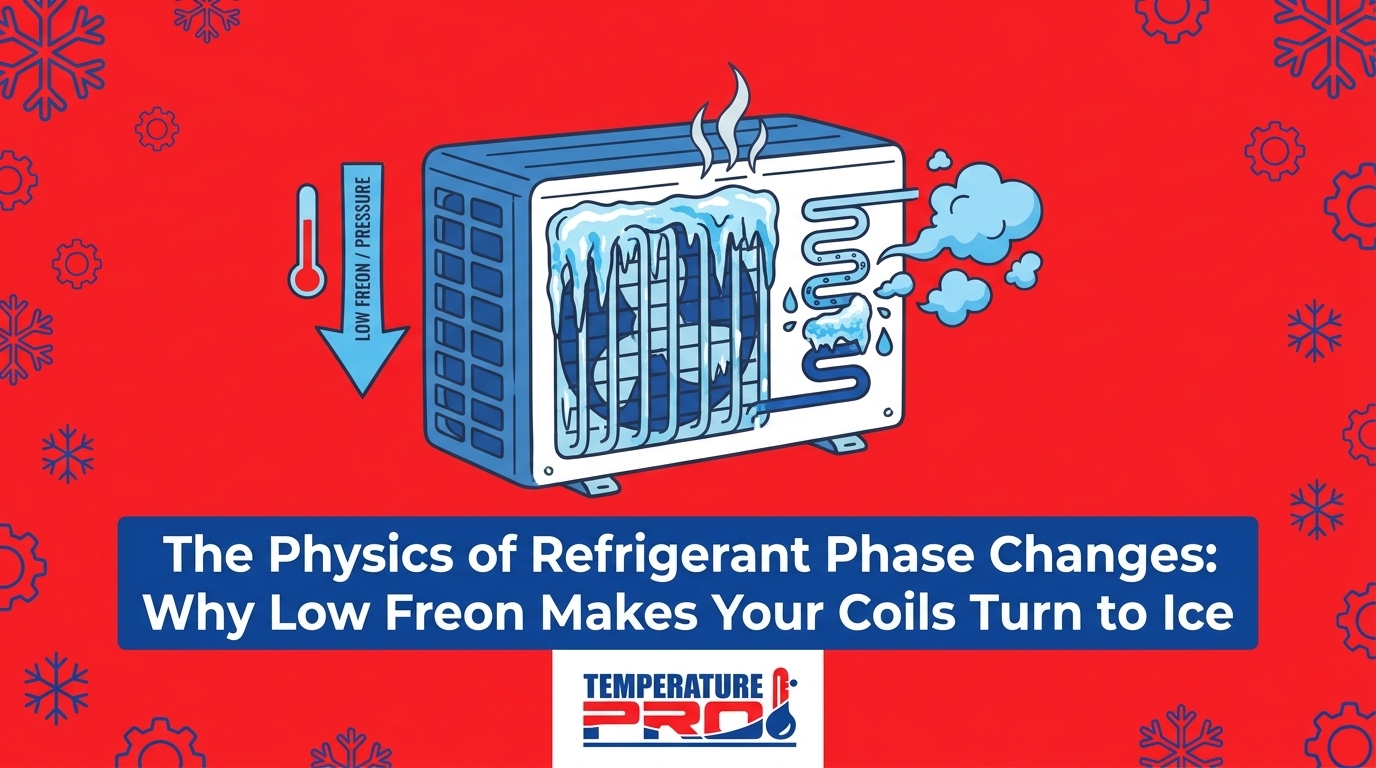
Finding a solid block of ice inside your AC during an August heat wave defies logic. We break down the counterintuitive pressure drops that cause freezing and why leak repair is the only solution.
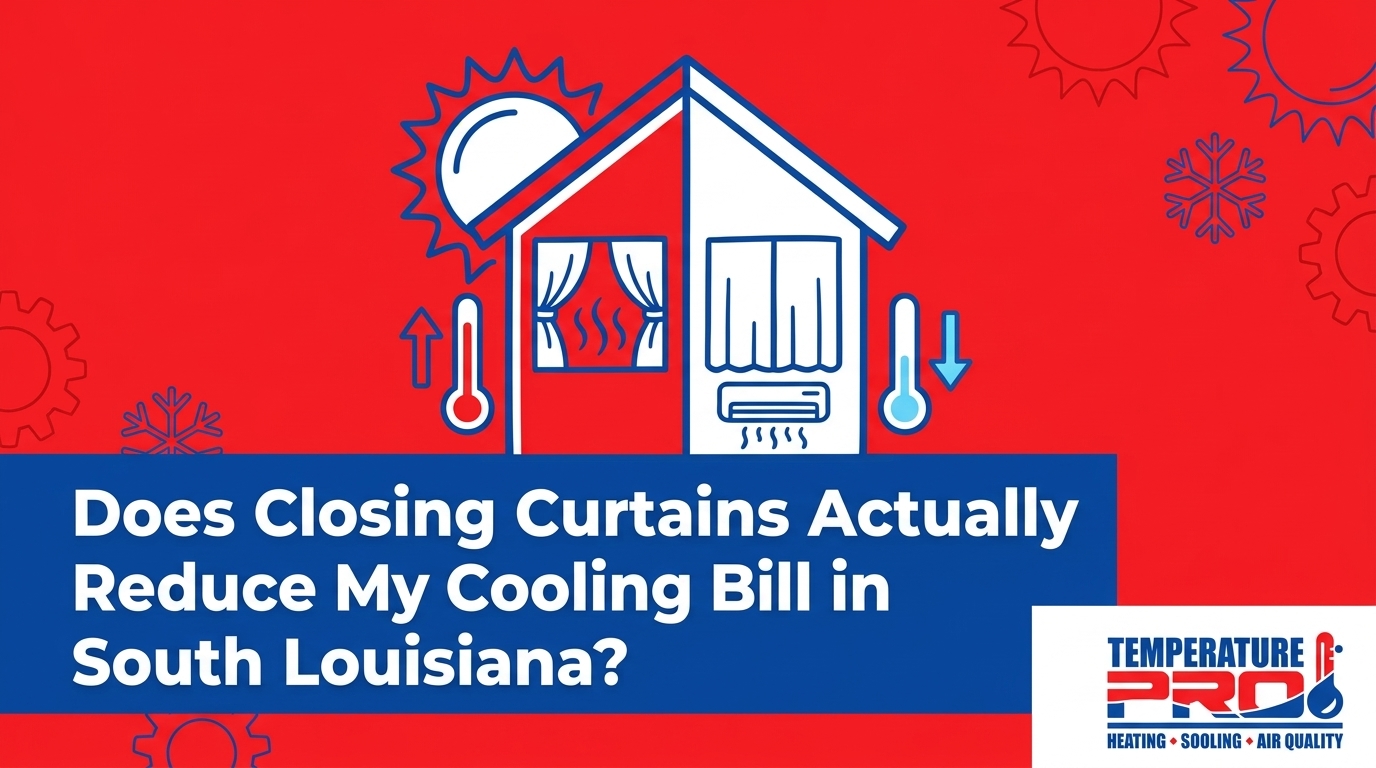
When late-summer heat hits, your AC works overtime to keep up. We break down the science of solar heat gain so you can decide if blackout curtains are worth it.