Transitioning Your Walk-In Cooler Defrost Cycles for Milder Autumn Nights
Transitioning Your Walk-In Cooler Defrost Cycles for Milder Autumn Nights
When hot kitchens meet dropping overnight temperatures, commercial coolers are vulnerable to severe ice buildup. Properly adjusting your defrost timers protects perishable inventory this fall.
The Hidden Threat to Your Walk-In Cooler This Fall
Before the first major cold front pushes through the Gulf Coast, your commercial refrigeration equipment enters a vulnerable phase. Transitioning your walk-in cooler defrost cycles for milder autumn nights is a critical operational step that many facility managers overlook during the September/October early fall transition. While your kitchen remains hot and busy during the day, the external environment cooling down overnight drastically changes how your compressor and evaporator coils operate. Leaving aggressive summer settings untouched as the weather shifts creates a perfect storm for ice buildup, wasted energy, and potential equipment failure.
If you wait until a solid block of ice forms on your evaporator coil to take action, you risk losing thousands of dollars in perishable inventory. Recognizing this seasonal shift is the first step; the crucial decision point is bringing in a professional to properly calibrate your defrost timers and fan controls rather than hoping the system sorts itself out. Securing reliable commercial HVAC and refrigeration services ensures your equipment adapts safely to the changing weather. By investing in proactive commercial HVAC solutions, you protect your bottom line and keep your kitchen running without unexpected interruptions.
Understanding the Shift: How Overnight Ambient Temperature Drops Affect Heat Loads
Commercial refrigeration systems are engineered and calibrated to handle the absolute worst-case scenarios. In southern Louisiana, that means fighting off peak summer heat loads when ambient outdoor temperatures hover in the upper nineties and kitchen doors are constantly swinging open. During these peak months, your walk-in cooler's compressor works overtime to reject heat, and the defrost cycles are set aggressively to manage the constant influx of warm, humid air.
However, the physics of refrigeration change dramatically when overnight ambient temperature drops begin to occur. As the outside air cools down, the heat load on your outdoor condensing unit is significantly reduced. The condenser can reject heat much more efficiently into 65-degree air than it can into 95-degree air. Mechanically, this means your walk-in cooler reaches its internal set point much faster. The compressor does not need to run as long to achieve the target temperature, which completely alters the necessary cycle times for the entire system.
The Day-to-Night Operational Disparity
During the shoulder season, your refrigeration system essentially develops a split personality. The high heat load of a busy, hot daytime kitchen requires robust cooling power, but the empty, cooler nighttime environment demands far less effort from the compressor. This day-to-night operational disparity means that a defrost schedule optimized for a busy August afternoon is entirely inappropriate for a quiet October night.
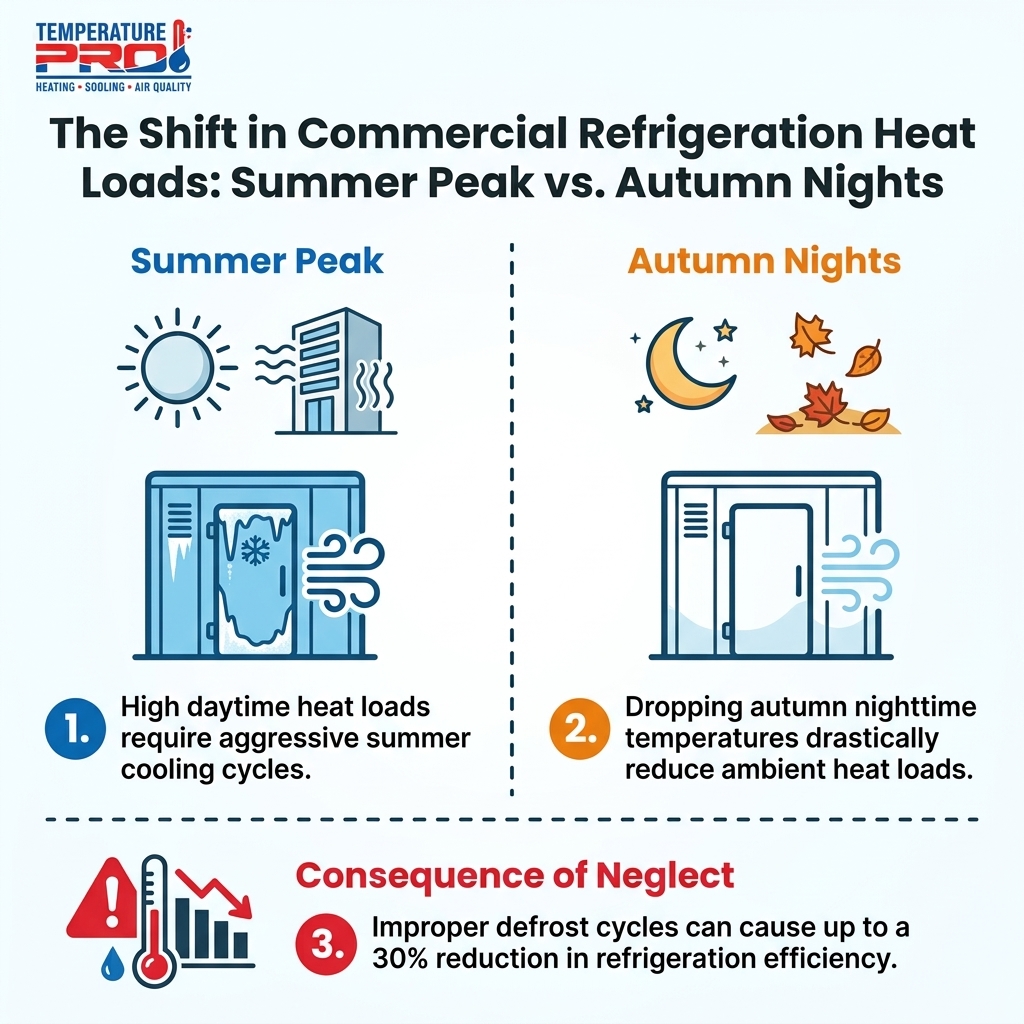
• Ambient Heat Load — Peak Summer Conditions: Consistently high, forcing long compressor run times. — Early Fall Nighttime Conditions: Significantly reduced, leading to shorter cooling cycles.
• System Set Point — Peak Summer Conditions: Takes longer to reach due to constant door openings. — Early Fall Nighttime Conditions: Reached rapidly in a closed, cooler environment.
• Defrost Requirement — Peak Summer Conditions: Frequent and long to combat heavy condensation. — Early Fall Nighttime Conditions: Requires shorter, less frequent cycles to prevent freezing.
The Shift in Commercial Refrigeration Heat Loads: Summer Peak vs. Autumn Nights
Why Leaving Summer Defrost Cycles Active Causes Evaporator Coil Freezing
The Problem: When you leave your walk-in cooler's defrost settings programmed for July, the system continues to execute long, aggressive cooling and defrost cycles even when the ambient heat load no longer justifies them. Because overnight ambient temperature drops allow the cooler to reach its target temperature quickly, the compressor shuts off sooner. However, the pre-programmed defrost timers and fan cycle controls are still operating on a heavy-duty schedule.
The Cause: Evaporator coil freezing occurs when aggressive cooling cycles run against a reduced ambient heat load. In a walk-in cooler, the fans continuously circulate air over the evaporator coils to remove heat. During the summer, frequent defrost cycles melt away the heavy condensation that accumulates from humid kitchen air. But in the fall, when the compressor runs in short bursts because the ambient air is already cool, unnecessary defrost cycles or insufficient fan cycling can trap moisture on the cold coils. Without enough warm air moving across the coils to assist in natural evaporation, that trapped moisture freezes directly onto the metal fins.
The Solution: The only way to stop this cycle is to have a professional recalibrate the defrost timer and fan delay controls. If the ice buildup goes unnoticed overnight, it acts as an insulator. The system will then run continuously trying to pull the temperature down, which can lead to total compressor failure and devastating product loss. Adjusting the cycle times prevents the initial frost from compounding into a solid block of ice.
The Role of High Humidity During the Early Fall Transition
In the Baton Rouge area, the transition into fall is rarely a clean break from summer weather. We experience a distinct climate pattern where the September/October early fall transition brings milder nights, but the heavy, oppressive humidity remains stubbornly high. This specific combination of cooling nighttime temperatures and lingering airborne moisture creates a unique operational hazard for commercial refrigeration.
Even as the air cools, the high moisture content means that rapid condensation occurs the moment that humid air meets a heavily cooled evaporator coil. Because the overnight temperatures are lower, the air cannot hold as much moisture, pushing it to its dew point much faster inside your walk-in cooler.
• Rapid Condensation: Humid air entering the cooler during the day settles and condenses quickly as the ambient temperature drops at night.
• Flash Freezing: If the fan cycle controls are not synchronized to clear this moisture, the condensation turns to ice almost immediately upon contact with the super-cooled evaporator fins.
• Compounding Frost: Once a thin layer of ice forms, it attracts more moisture, rapidly compounding into a thick barrier that blocks airflow entirely.
This stark contrast between hot, humid September days and suddenly milder nights means that standard, out-of-the-box defrost settings are rarely sufficient. Your system must be precisely tuned to handle the persistent humidity without over-cooling during the vulnerable nighttime hours.
Energy Waste: The Cost of Ignoring Fan Cycle Controls
Beyond the immediate threat of equipment failure, failing to adjust your defrost timers is a massive source of energy waste. Walk-in coolers and freezers account for a significant portion of a commercial kitchen's baseline energy consumption. According to industry data from ASHRAE and ENERGY STAR, commercial refrigeration is one of the most energy-intensive systems in any food service facility. When you ignore the seasonal transition, you are essentially paying for cooling power you do not need.
Iced evaporator coils and improper defrost cycles can reduce commercial refrigeration efficiency by up to 30%. When ice forms on the evaporator coil, it creates a thermal barrier. The refrigerant inside the coil can no longer effectively absorb heat from the air inside the box. As a result, the thermostat never registers that the target temperature has been reached, forcing the compressor to run continuously.
Forcing a compressor to run with frozen coils draws excessive amperage. The motor works harder, runs hotter, and consumes significantly more electricity just to maintain a baseline temperature. Optimizing these controls is not just about preventing breakdowns; it is a critical component of broader facility energy management. By ensuring your defrost cycles match the overnight ambient temperature drops, you reduce unnecessary electrical draw. For more strategies on managing your facility's utility footprint, exploring methods for reducing cooling costs without sacrificing comfort can yield substantial operational savings throughout the year.
Why Adjusting Defrost Timers Requires a Professional Approach
It can be tempting for a facility manager or maintenance staff member to open the control panel and attempt to manually alter defrost pins on a mechanical timer or adjust the parameters on a digital cycle control. This is a high-risk gamble. Commercial refrigeration systems are highly complex, and adjusting one component without understanding its impact on the rest of the system can cause catastrophic damage.
Working with a veteran-owned company means you benefit from a highly disciplined operational approach. We treat seasonal refrigeration tuning as a strict, preventive protocol rather than a reactive afterthought. A licensed professional understands the complex interplay between pressure switches, ambient thermostats, and defrost timers. Here is what a professional technician actually does when calibrating your system for the fall:
1. Verifying Refrigerant Charge: Before adjusting any timers, the technician ensures the system has the correct refrigerant levels, as a low charge can also cause coil freezing.
2. Testing Defrost Heaters: The technician measures the amperage of the defrost heaters to confirm they are activating correctly and generating enough heat to clear the coils.
3. Calibrating Fan Delays: After a defrost cycle, the fans must remain off for a specific duration to allow water to drain. The technician precisely calibrates this delay so moisture isn't blown back onto the coils.
4. Adjusting Defrost Frequency: Based on the September/October early fall transition conditions, the technician reduces the number of daily defrost cycles to match the lower ambient heat load.
5. Inspecting Defrost Termination Switches: The technician verifies that the switch cuts off the defrost cycle exactly when the ice is melted, preventing unnecessary heat buildup inside the cooler.
Professional calibration is a critical risk management step for B2B operations. One wrong adjustment to a digital controller can cause the compressor to short-cycle or bypass the safety limits, leading to a total system failure.
Securing Your Commercial Kitchen with a Preventative Strategy
The operational risks associated with the September/October early fall transition should automatically trigger a scheduled check-up for your commercial refrigeration equipment. Shifting from a reactive mindset—waiting for the walk-in cooler to start running warm—to a proactive, year-round maintenance strategy is the best way to protect your inventory and your budget.
Routine monitoring prevents the 30% efficiency loss before it ever impacts your bottom line. When you have a structured plan in place, professional technicians automatically adjust your fan cycle controls, clear your condensate drains, and calibrate your defrost timers as the seasons change. This ensures your equipment operates at peak efficiency whether it is the middle of a July heatwave or a mild October night.
Facility managers should lock in their seasonal transition protocols well before the weather shifts. Enrolling in a comprehensive preventative maintenance plan takes the guesswork out of seasonal adjustments. By letting experienced professionals manage the complex timing and calibration of your refrigeration controls, you can focus on running your kitchen, confident that your valuable inventory is protected against unexpected temperature drops and costly ice buildup.
Frequently Asked Questions
Why is my walk-in cooler freezing up at night? Your walk-in cooler is likely freezing at night because the ambient outdoor temperature has dropped, reducing the heat load on the system. If the summer defrost settings are still active, the system over-cools, and lingering humidity condenses and freezes on the evaporator coils. A professional needs to adjust the fan and defrost cycles to match the cooler nighttime conditions.
How often should a commercial cooler go into defrost? The ideal defrost frequency depends heavily on the season, ambient humidity, and how often the cooler doors are opened. In peak summer, a cooler might need three to four defrost cycles per day to manage heavy condensation. During the cooler fall and winter months, this frequency often needs to be reduced by a professional to prevent unnecessary heating and energy waste.
What causes ice buildup on evaporator coils in a walk-in cooler? Ice buildup is typically caused by restricted airflow, low refrigerant levels, or improperly calibrated defrost timers. When the defrost cycle doesn't run long enough—or runs too often without proper fan delays—moisture gets trapped on the super-cooled fins and freezes. Once a thin layer of ice forms, it insulates the coil, causing more ice to rapidly accumulate.
Can I manually adjust the defrost timer on my commercial freezer? You should never attempt to manually adjust the defrost timer or digital cycle controls on commercial refrigeration equipment. These controls are intricately linked to pressure switches, fan delays, and defrost heaters. Improper adjustments can lead to compressor failure, severe icing, or unsafe food storage temperatures, requiring a licensed technician to calibrate them safely.
How does ambient temperature affect my walk-in cooler's performance? Ambient outdoor temperature dictates how hard your condenser must work to reject heat. When outside temperatures drop in the fall, the system rejects heat more easily, causing the cooler to reach its target temperature much faster. This change in run time completely alters how condensation forms and drains, which is why seasonal calibration is necessary to maintain performance.
Ready to protect your inventory? Don't let unpredictable autumn nights cause a catastrophic freeze-up in your walk-in cooler. Schedule your professional calibration today to lock in your seasonal transition protocols, ensuring your commercial refrigeration runs efficiently and your valuable inventory stays perfectly chilled.
Thank you! Your submission has been received!
Oops! Something went wrong while submitting the form.
When autumn weather turns your dining room into a wind tunnel, your heating system likely isn't to blame. Balancing your restaurant's make-up air solves severe negative pressure drafts.
Property managers prepping multi-family duplexes for the fall heating season face a crucial choice. Evaluate the safety of electric systems against the fast recovery of gas.
A failing defrost control board won't show symptoms in mild autumn weather, but it can turn your outdoor coil into an ice block this winter. See how our technicians catch silent failures early.