5 min read
Why Is My Heat Pump Emitting a Burning Smell During Its First Fall Cycle?
That alarming odor on the first chilly morning is usually just summer dust burning off your heat strips. Find out how long it should last before you need to worry.


Lower autumn sun angles can directly hit your thermostat, causing false high readings that force your AC to run non-stop. See whether relocating the device or adding remote sensors is the best fix.
As the calendar flips and the seasons transition, understanding how we calibrate thermostat sensors to account for changing sun angles in September becomes the unexpected key to stopping your air conditioner from freezing out your living room. The late summer and early fall weeks bring a noticeable shift to the afternoon sky. Suddenly, a thermostat that remained safely shaded all through June and July finds itself bathed in harsh, direct sunlight by 4:00 p.m. When this happens, your cooling system receives terrible data, forcing it to run continuously while the rest of your house drops to uncomfortable temperatures.
When seasonal shifts throw your system off balance, relying on professional HVAC services ensures your home receives the precise air conditioning repair and optimization it needs.
This sudden onset of severe over-cooling frustrates countless homeowners every autumn. You check the thermostat, and it reads 82 degrees, even though you are shivering on the couch. The immediate reaction is often panic—assuming the air conditioner is broken or the thermostat needs to be ripped off the wall. However, this is rarely a mechanical failure. Instead, it is an environmental conflict caused by the September early fall sun angle striking the sensor.
Fixing this issue requires a professional decision matrix. We have to evaluate whether the unit needs a software offset, a physical relocation, or the deployment of modern wireless sensors. This is not a quick DIY fix you can solve by taping a piece of cardboard over the screen. It requires precise diagnosis to restore your home's thermal balance without damaging sensitive low-voltage wiring.
The transition into autumn brings significant astronomical shifts that directly impact how your home absorbs heat. In Baton Rouge, September brings a noticeable shift in the sun's trajectory even while outdoor temperatures stubbornly remain in the upper 80s and low 90s. This combination means that your air conditioner is still facing peak-level demand, but the environmental data it relies on is suddenly being scrambled by new light patterns.
During the peak of summer, the sun sits high in the sky. Roof overhangs, eaves, and window lintels do an excellent job of blocking direct sunlight from entering your home. However, as the autumnal equinox approaches, the sun's path across the sky lowers significantly. This lower angle acts like a spotlight, allowing ultraviolet and infrared light to penetrate much deeper into your living spaces than it did just a few weeks prior. Summer shading strategies—like planting trees or relying on your porch roof—suddenly fail because the light is coming in underneath those barriers.
Thermostats are highly sensitive instruments housed in plastic casings. When direct sunlight hits that casing, the physics of heat transfer take over. The dark digital screens and plastic materials absorb the solar radiation and retain it. Because the internal temperature sensor is located just millimeters behind that plastic shell, it begins reading the temperature of the heated plastic, not the air in the room. This creates a localized hot spot, essentially baking the sensor in a miniature oven while the rest of the room remains perfectly cool.
• Sun Trajectory — Mid-Summer Conditions: High angle, blocked by roof overhangs — September Equinox Conditions: Low angle, penetrates deep into rooms
• Thermostat Exposure — Mid-Summer Conditions: Safely shaded by interior walls — September Equinox Conditions: Directly exposed to afternoon glare
• Sensor Reading — Mid-Summer Conditions: Accurately reflects ambient room air — September Equinox Conditions: Artificially inflated by heated casing
• System Behavior — Mid-Summer Conditions: Cycles normally based on actual heat — September Equinox Conditions: Runs constantly to fight false heat
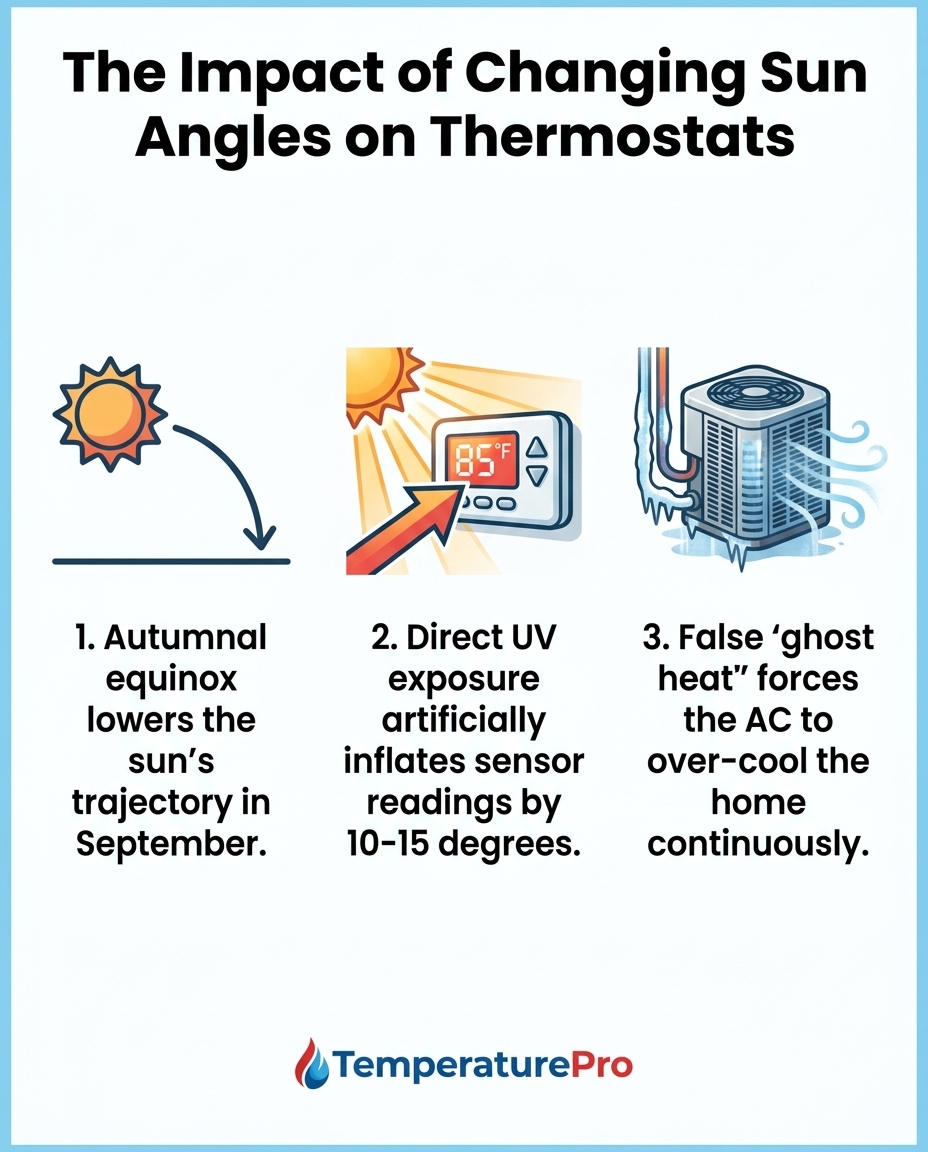
When sunlight bakes your thermostat casing, it creates a frustrating condition known as "ghost heat." This refers to the artificial inflation of the sensor reading, often pushing the displayed temperature 10 to 15 degrees above the actual ambient room conditions. The heat isn't real—at least, not in the room itself—but the thermostat doesn't know the difference. It simply reacts to the data it gathers.
There is a massive difference between the ambient air you feel on your skin and the concentrated heat trapped inside the sensor housing. Even if your ceiling fans are running and the air vents are blasting cold air, airflow alone cannot cool the sun-baked plastic casing fast enough to offset the direct solar radiation. The sensor remains trapped in its own microclimate, entirely disconnected from the reality of the room. This disconnect is a major factor in why your air conditioner struggles in the late afternoon, as the system tries to achieve an impossible goal.
Ghost heat triggers a relentless chain reaction. The thermostat registers 85 degrees and sends a continuous call for cooling to your HVAC equipment. Because the sun continues to heat the casing, the reading never drops to your desired setpoint. The air conditioner runs for hours on end, dumping freezing air into unaffected rooms. This severe over-cooling not only makes your home miserably cold, but it also places unnecessary, extreme strain on your compressor, blower motor, and ductwork, drastically reducing the system's energy efficiency and long-term lifespan.
Not every house experiences this autumn phenomenon equally. The architecture, orientation, and interior layout of your property play a massive role in whether your thermostat falls victim to the September equinox. Understanding your home's vulnerabilities helps you anticipate the problem before your system runs nonstop.
The most disruptive sun angles typically occur between 3:00 p.m. and 6:00 p.m. during the early fall. Identifying the light patterns in your home is the first step to understanding the issue.
• High-risk orientations: Baton Rouge homes with west or south-facing windows take the brunt of the harsh afternoon sun, making them highly susceptible to seasonal glare.
• Light tunnels: Long hallways aligned with exterior windows can act as literal light tunnels, channeling the low autumn sun directly onto walls that are shaded the rest of the year.
• Open-concept challenges: Homes with wide-open floor plans often lack the protective interior partition walls needed to keep thermostats safely in the shadows.
The Department of Energy explicitly recommends placing thermostats on interior walls, away from direct sunlight, drafts, skylights, and exterior doors. However, during construction, builders frequently prioritize convenience over climate accuracy. They mount thermostats near return air grilles or in central walkways to save on wiring costs. While this might look neat on a blueprint, these poor initial installation locations become glaring liabilities years later when the seasonal sun angles shift and strike the unit directly.
When an air conditioner runs constantly and over-cools a house, many homeowners immediately fear a catastrophic equipment failure. Our diagnostic thoroughness sets our process apart—instead of unnecessarily replacing expensive equipment when an AC over-cools, our technicians analyze environmental factors like sun exposure to properly offset or relocate sensors. Proving the issue is environmental saves you from paying for repairs you don't actually need.
A typical pattern we see involves diagnosing complex AC issues where a clear plan is needed. One local homeowner reached out in the spring to diagnose persistent AC issues that seemed impossible to pin down. By running a comprehensive environmental and mechanical assessment, our technicians helped create a clear, targeted plan for repairs, giving the customer a precise path forward without guessing. We apply this exact same rigor to sun-blinded thermostats.
1. Deploying calibrated tools: Technicians use highly sensitive, professional-grade psychrometers and thermometers to measure the real conditions in the center of the room.
2. Establishing a baseline: We record the actual room temperature and humidity levels to establish a factual baseline.
3. Comparing the data: We compare our baseline data against the digital output displayed on the wall unit. If our tools read 72 degrees but the wall unit reads 84 degrees, we have confirmed false high ambient temperature readings.
4. Ruling out mechanical failure: By verifying that the system is successfully producing cold air and moving it through the house, we rule out bad compressors, refrigerant leaks, or failing blower motors. You can learn more about this diagnostic process through our HVAC troubleshooter resources.
1. Mapping the sun's path: We observe how the light enters the room and tracks across the face of the thermostat casing.
2. Checking surface temperatures: Using an infrared laser thermometer, we measure the physical surface temperature of the plastic casing to prove it is absorbing solar radiation.
3. Finalizing the diagnosis: Once we confirm the sun is the culprit, we can stop troubleshooting the heavy equipment outside and focus entirely on the control system inside.
Once we prove that the changing sun angle is causing the ghost heat, we have to implement a professional solution. Leaving the system to battle the sun is not an option. The decision generally comes down to adjusting the software or moving the hardware.
Most modern digital thermostats feature a hidden installer menu that allows professionals to adjust the internal calibration offset. This is a software adjustment that tells the unit to permanently subtract a certain number of degrees from its reading. If the offset is set to -3, and the sensor feels 75 degrees, it will display and act upon 72 degrees.
The limitations of offsets: While a calibration offset is a fast, non-invasive fix, it is not always the best solution for sun exposure. Sunlight is dynamic; it varies by the hour and the cloud cover. If we calibrate the thermostat to ignore 10 degrees of heat at 4:00 p.m., the thermostat will read 10 degrees too cold at 8:00 p.m. when the sun goes down. Offsets are best used for minor, consistent temperature discrepancies, not massive, temporary solar spikes.
When an offset won't cut it, physical relocation of the thermostat is often the next logical step. Moving the unit to a shaded interior hallway permanently solves the solar exposure problem. However, this is a complex process.
Thermostats rely on a bundle of hardwired, low-voltage communication lines that run behind your drywall, up into your attic, and out to your equipment. Navigating these wires requires professional expertise. Attempting to pull, splice, or reroute these wires on your own carries significant risks. A single crossed wire can short out your furnace control board or blow a critical fuse in your air handler. Licensed professionals ensure the wiring is handled safely, the new location is optimal, and the old hole in your drywall is properly addressed.
If hardwired relocation sounds too invasive or requires too much drywall repair, the HVAC industry offers an elegant, modern alternative: wireless indoor temperature sensors. These small, unobtrusive devices serve as the ultimate workaround for a sun-blinded main thermostat.
Wireless sensors communicate directly with your main smart thermostat via low-frequency radio waves or Wi-Fi. A technician can mount these sensors in shaded, temperature-stable areas of your home—like a master bedroom or an interior den. Once activated, the main thermostat stops relying solely on its own internal sensor. Instead, it averages the climate data from multiple rooms.
Even better, most modern systems allow us to program the thermostat to completely ignore the main wall unit during specific hours. If we know the September sun hits the main unit at 4:00 p.m., we can instruct the system to only read the remote sensors between 3:00 p.m. and 6:00 p.m. This perfectly bypasses the ghost heat without moving a single wire.
During a system replacement or upgrade, a technician will often walk a customer through each step of optimizing their new unit and thermostat, ensuring they make the best decision for long-term comfort. Deploying wireless sensors is a seamless extension of that optimization process. They are highly compatible with most modern smart thermostats and offer a quick deployment without structural modifications. Combining this technology with routine AC maintenance ensures your system responds accurately to your home's actual needs, rather than the seasonal whims of the afternoon sun.
Severe AC over-cooling in September is an incredibly frustrating problem, but it is entirely solvable. You do not have to endure a freezing house just because the autumn sun decided to shine on your wall. By understanding the environmental factors at play, you can stop fighting your HVAC system and start enjoying the season. If you are tired of battling false high ambient temperature readings every afternoon, reach out for a professional assessment. We can deploy precise calibration adjustments or integrate smart wireless sensors to restore your home's comfort today.
Why is my thermostat reading higher than the actual room temperature?
Your thermostat is likely absorbing localized heat from its environment, causing a false high reading. This often happens when the plastic casing is exposed to direct sunlight, warm drafts, or heat-generating appliances nearby. Because the internal sensor measures the temperature inside the casing, it reacts to this trapped heat rather than the actual ambient air in your room.
How does direct sunlight affect a thermostat?
Direct sunlight bakes the outer casing of the thermostat, drastically inflating the internal temperature sensor's reading. This creates "ghost heat," which tricks your HVAC system into thinking the entire house is dangerously hot. As a result, the air conditioner will run continuously in a futile attempt to cool down a sun-baked piece of plastic on the wall.
How do you fix a thermostat in direct sunlight?
The most effective fixes involve bypassing the sun-exposed sensor entirely. A professional can physically relocate the hardwired thermostat to a shaded interior wall, or they can deploy wireless remote indoor sensors. Remote sensors allow the system to read the temperature from shaded rooms and ignore the main unit while the sun is hitting it.
Why does my AC run constantly in the late afternoon?
Late afternoon is when the sun's angle is lowest, allowing intense light to penetrate deep through west and south-facing windows. If this light strikes your thermostat, it artificially spikes the temperature reading. The AC runs constantly because it is trying to cool down a sensor that is actively being heated by solar radiation.
Can a thermostat's internal calibration offset fix sun exposure issues?
An internal calibration offset is generally not the best solution for direct sun exposure. Offsets apply a permanent, fixed temperature adjustment, but sunlight changes by the hour and by the season. If you offset the thermostat to ignore the sun at 4:00 p.m., the reading will be wildly inaccurate at 8:00 p.m. when the sun goes down.
Are wireless remote sensors a better option than moving my thermostat?
Wireless remote sensors are often the preferred option because they require no drywall patching or rerouting of low-voltage wires. They allow you to leave the main thermostat where it is while gathering accurate temperature data from shaded areas of the home. This provides a non-invasive, highly customizable solution to seasonal sun exposure.
Go With Experience