Can I Hose Off My Outdoor AC Unit to Make It Run Cooler?
Can I Hose Off My Outdoor AC Unit to Make It Run Cooler?
When your AC struggles in the late-summer heat, spraying it with a garden hose seems like a logical quick fix. Find out why this actually bakes mud and minerals onto your coils.
Is Spraying Your Air Conditioner a Good Idea in the Late-Summer Heat?
When facing the brutal August heat in Baton Rouge, you might find yourself staring at an overworked system and asking, "Can I Hose Off My Outdoor AC Unit to Make It Run Cooler?" When late-summer temperatures push indoor heat up, and your system runs continuously without cooling the house, it is completely normal to look for a fast solution. The short answer is no. Hosing off your AC unit with municipal tap water is not recommended. While it might offer a few minutes of evaporative cooling, it pushes dirt deeper into the system and causes long-term mineral buildup that permanently damages efficiency.
The temptation to cool down a struggling air conditioner is completely understandable. As families prepare for the back-to-school transition and the relentless late-August heat pushes systems to their absolute limits, homeowners often become desperate for quick relief. We use cool water to lower our own body temperatures, so it seems perfectly logical to apply the exact same logic to a hot metal box sitting in the sun. However, modern HVAC equipment operates on precise thermodynamic principles. Introducing unpressurized, untreated tap water to the exterior of a running condenser disrupts those principles and introduces a host of mechanical problems that far outweigh any temporary drop in air temperature.
The Hidden Danger of Hard Water on Hot Condenser Coils
To understand why a garden hose is harmful, you have to look at the physics of heat transfer. Your outdoor unit, known as the condenser, has one primary job: taking the heat absorbed from inside your home and rejecting it into the outdoor air. It does this by pumping hot refrigerant through a series of copper tubes surrounded by hundreds of thin aluminum fins.
The Evaporation Trap
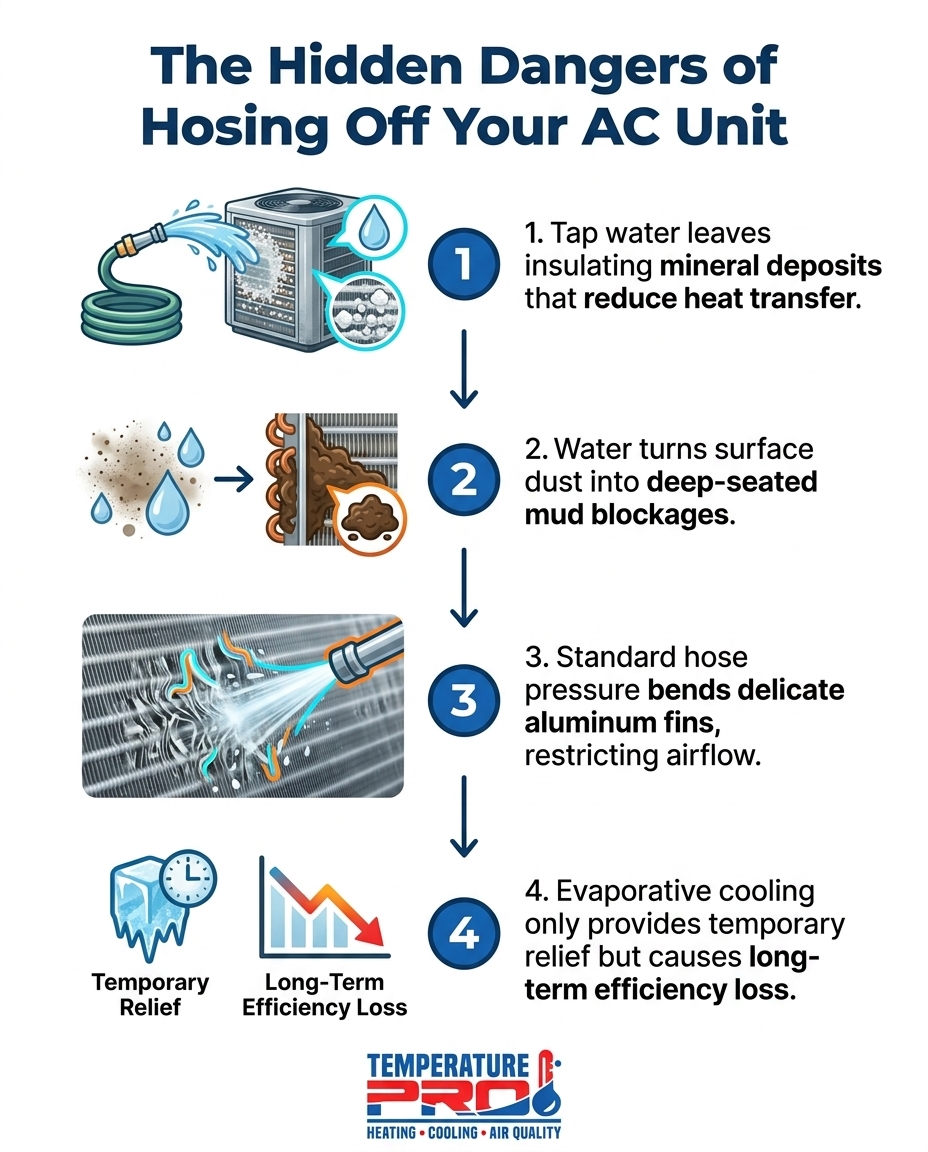
When you spray cold municipal tap water onto a hot, running condenser coil, the water evaporates almost instantly. This rapid evaporation is what causes the temporary cooling effect you might feel inside the house. However, municipal tap water in Baton Rouge contains dissolved minerals, primarily calcium and magnesium. When the water evaporates, those hard minerals do not evaporate with it. Instead, they are left behind, baking directly onto the hot aluminum fins.
Why Mineral Scale Acts as Insulation
Over time, this leftover hard water scale builds up into a chalky, crusty layer across the surface of the coil. The hidden danger: this mineral crust acts as a highly effective thermal insulator. Because the aluminum fins are now coated in a layer of calcium carbonate, they can no longer transfer heat efficiently into the surrounding air. Our technicians at TemperaturePro Baton Rouge routinely replace overworked compressors that failed prematurely simply because a well-meaning homeowner repeatedly hosed down their unit. The compressor is forced to run longer and work significantly harder to achieve the same amount of cooling. What started as an innocent attempt to cool the system down ultimately traps more heat inside the unit, accelerating wear and tear on the most expensive components in your HVAC system.
How Garden Hoses Create a Destructive 'Mud Packing' Effect
Beyond the invisible threat of mineral scaling, spraying your air conditioner creates an immediate, highly destructive mechanical issue. Outdoor units sit in the elements 365 days a year. They naturally accumulate a fine, dry layer of environmental debris, including dust, pollen, lawn clippings, and airborne dirt.
When this debris remains dry, the powerful fan inside the condenser can usually still pull enough air through the microscopic gaps to keep the system functioning. But the moment you introduce a garden hose, the situation changes drastically.
The Journey from Dust to Solid Blockage
1. The Wetting Phase: The water from your hose mixes with the fine layer of surface dust, instantly turning it into a thick, sticky mud on the exterior of the unit.
2. Deep Penetration: The water pressure from the hose acts like a ram, forcing this newly created mud deep into the center of the delicate, tightly packed V-coils where it cannot be easily seen or reached.
3. The Baking Process: Once you turn the hose off, the immense heat generated by the running AC unit quickly bakes the wet mud into a solid, brick-like substance lodged deep inside the fins.
4. Total Airflow Restriction: This dried mud forms a solid blockage that completely chokes off airflow, forcing the system to suffocate as it battles the August late-summer heat.
Because this mud is pushed so deeply into the system, standard surface brushing will no longer remove it. If you want to maintain your system's exterior without causing this damage, learning how to clean your AC condenser safely using gentle, dry methods is a much better approach.
The Risk of Bent Fins and Permanent Airflow Restriction
Even if your unit is perfectly free of dust and you use filtered water, the sheer physical force of a garden hose presents a massive risk to your equipment. The aluminum condenser fins surrounding your outdoor unit are incredibly thin—often thinner than a piece of paper. They are engineered this way to maximize surface area for heat dispersion, making them highly efficient but remarkably fragile.
Standard residential water pressure, especially when concentrated through a garden hose spray nozzle, easily exceeds the physical threshold these delicate fins can withstand. When hit with a direct stream of water, the fins bend inward and fold over each other like dominoes.
The permanent consequence: When fins are flattened, they create a solid wall of bent metal. The fan can no longer pull air through the sides of the unit in that specific area. The U.S. Department of Energy explicitly warns that restricted airflow insulates the coil, crippling the system's efficiency and drastically reducing its ability to absorb or release heat. Once these fins are folded over, they cannot be fixed with a hose; they require specialized tools and extreme patience to repair.
The Hidden Dangers of Hosing Off Your AC Unit
Why DIY Cooling Hacks Fail When You Need Them Most
The biggest reason homeowners continue to hose down their AC units is the psychological temptation of the quick fix. When you spray a struggling condenser, the immediate drop in air temperature coming from your indoor vents feels like a massive success. You might think you have just saved the day and outsmarted the August late-summer heat.
Here is the reality: that evaporative cooling effect only lasts for a few minutes. As soon as the water evaporates, the system returns to its previous state—except now it is burdened with a fresh layer of insulating mineral scale and deep-seated mud.
Overworked units running at maximum capacity during a heat wave cannot afford any drop in efficiency. Every fraction of a percent of heat transfer lost to mineral buildup or bent fins forces the compressor to run hotter and longer. Eventually, the compressor will overheat and trigger a safety shutdown, leaving you completely without air conditioning when you need it most. If your system is exhibiting signs of strain, using an HVAC troubleshooter to identify the real issue is always a safer bet than experimenting with water.
Professional Coil Cleaning vs. The Garden Hose Approach
There is a massive difference between a homeowner blasting a condenser with a garden hose and a certified technician performing a professional coil cleaning. Certified technicians understand the specific mechanical vulnerabilities of AC systems in extreme Southern climates and never rely on risky, high-pressure washing to get the job done.
During the intense summer heat following Hurricane Ida, one Baton Rouge homeowner spotted one of our TemperaturePro trucks in their neighborhood and flagged our technician down for an emergency inspection. The customer's AC unit was covered in storm debris and struggling to cool the house. Instead of relying on a risky garden hose trick, our technician performed a prompt, professional inspection and safely restored the system's airflow using proper techniques.
• Cleaning Agent — DIY Garden Hose Hack: Hard municipal tap water — Professional Coil Cleaning: Non-corrosive chemical coil cleaners
• Debris Management — DIY Garden Hose Hack: Pushes dirt deeper into fins — Professional Coil Cleaning: Lifts dirt out without mineral scale
• Fin Care — DIY Garden Hose Hack: High risk of bending and flattening — Professional Coil Cleaning: Includes straightening with a fin comb
Professional maintenance also identifies the underlying issues causing the unit to overheat in the first place, such as low refrigerant or a failing capacitor. Enrolling in a preventative AC maintenance plan ensures these deep cleanings happen safely and on schedule.
Frequently Asked Questions About Cooling Your Outdoor AC Unit
When the temperature spikes, homeowners naturally search for ways to help their systems survive the strain. Before you try any DIY methods, reviewing these common HVAC questions can save you from accidentally causing expensive damage to your condenser.
Does pouring water on an AC unit help it cool?
It provides a very brief, temporary drop in temperature due to the rapid evaporation of the water on the hot coils. However, long-term, it leaves behind insulating mineral deposits that worsen overheating and force the compressor to work much harder.
Is it safe to spray my AC condenser?
No, high-pressure water from a standard garden hose can easily bend the delicate aluminum fins, permanently restricting necessary airflow. Furthermore, water pushes surface dirt deeper into the unit, creating a solid mud blockage that is incredibly difficult to remove.
Can I spray water on my AC unit while it's running?
Spraying a running unit accelerates the evaporation of hard municipal water, baking calcium and magnesium directly onto the hot coils. It also introduces unnecessary electrical and mechanical risks to a system that is already operating under extreme stress.
How do I clean the outside of my AC unit safely?
You can gently brush away loose leaves, cottonwood, and environmental debris from the exterior using a soft-bristle brush or a dry vacuum. Leave deep coil cleaning to professionals who use specialized low-pressure chemical treatments that lift dirt safely.
What is the safest way to improve my AC's airflow?
Keep a strict two-foot clearance around the entire unit by trimming bushes, cutting back tall grass, and removing debris. Additionally, schedule a professional tune-up to safely clean the internal coils, check refrigerant levels, and ensure the fan motor is operating efficiently.
Keep Your System Running Cool the Right Way
While the August late-summer heat is undeniably oppressive, reaching for a garden hose will only cause expensive, long-term damage to your equipment. The temporary blast of cool air is never worth the permanent mineral scaling, the deep-seated mud packing, or the flattened aluminum fins that result from unpressurized tap water.
If your system is running constantly and struggling to keep your home comfortable, there is usually an underlying mechanical issue that needs attention. Scheduling a professional inspection provides a definitive diagnosis and offers safe, non-damaging alternatives to improve airflow and efficiency, ensuring your home stays cool without putting your investment at risk.
Thank you! Your submission has been received!
Oops! Something went wrong while submitting the form.
Peak late-summer humidity forces your AC to work overtime, triggering rapid algae blooms in the drip pan. Recognizing a sluggish condensate line early prevents unexpected overflows that ruin your ceiling.
When the late-summer August sun turns your retail space into an oven, standard RTU calculations fail. Find out how solar heat gain impacts commercial cooling loads.
Discovering a refrigerant leak in late summer forces a tough choice. Use our diagnostic framework to decide if patching an older R-410A system is worth the investment.