5 min read
Fall HVAC Troubleshooting: Why Your Heater Smells Like Burning Dust on Startup
Is that burning dust smell normal? Read our home maintenance tips and troubleshooting to see why heating startup odors happen and when to call a professional.


Finding degraded flex ducts in your hot attic forces a tough choice before winter. Evaluate duct brittleness to confidently choose between a mastic seal and starting fresh.
Leaky ducts let heated air escape into an unconditioned attic before it reaches living spaces, forcing the heating system to run longer and use more energy. Checking duct integrity in early fall, before the first real chill, breaks that cycle.
The early fall cooldown is finally arriving in Baton Rouge, and while your air conditioner is getting a much-needed break, your furnace is gearing up for months of steady work. Before the first real chill settles in, there is one critical hidden component of your home you cannot afford to ignore. Navigating the decision between Patching Minor Duct Leaks with Mastic vs. Full Ductwork Replacement for Winter Efficiency during the early fall / September pre-heating transition can save you from massive energy waste. At TemperaturePro Baton Rouge, our team frequently discovers degraded, leaky flex ducts in sweltering attics during proactive early fall inspections. This common scenario forces a crucial choice: can the existing system be salvaged, or is it time to start fresh?
Many homeowners assume that a struggling heating system is the fault of the furnace itself. However, in our experience, the reality is often found directly above your ceiling. Heated air escaping into an unconditioned attic before it ever reaches your living space forces your equipment to run longer, work harder, and consume substantially more energy. Establishing a reliable, airtight delivery system is the foundation of effective heating services and comprehensive indoor air quality solutions. Addressing these hidden leaks now ensures that the warm air you pay to generate actually makes it into your bedrooms and living areas.
Ductwork operates under constant static pressure. When the blower motor kicks on, it forces conditioned air through a network of flexible tubes. If there are gaps, tears, or disconnected joints, that pressurized air takes the path of least resistance—straight out into your attic. Our technicians often see how this not only wastes heating energy but also creates negative pressure zones inside your home, which pull cold, unconditioned outdoor air in through drafts around windows and doors. Securing your duct integrity before winter arrives is the only way to break this cycle of inefficiency.
Baton Rouge-area attics frequently exceed 130 degrees in July and August. That heat breaks down plasticizers in a flex duct's outer jacket until it turns brittle and fails, leaking heated air into the attic in winter.
To understand why winter heating efficiency is so dependent on your ductwork, you have to look at what happens to those materials during the peak of a Baton Rouge summer. We regularly service unconditioned attics in our region that frequently exceed 130 degrees during July and August. Over time, this intense, trapped radiant heat physically alters the materials used to construct your HVAC delivery system.
Flexible ductwork consists of an inner wire helix wrapped in a thin plastic core, surrounded by fiberglass insulation, and encased in an outer plastic or metalized vapor barrier jacket. While these materials are designed to withstand normal attic conditions, the relentless, compounding thermal stress of extreme southern summers eventually takes a heavy toll. We typically see the degradation process follow a predictable sequence:
1. Radiant Heat Saturation: Day after day, the outer jacket absorbs extreme heat. The continuous cycle of expanding during the day and contracting at night stresses the material at a microscopic level.
2. Plasticizer Breakdown: The chemical compounds (plasticizers) that give the outer plastic vapor barrier its flexibility begin to evaporate and break down. The material transitions from pliable and tough to rigid and fragile.
3. Micro-Fissuring: As the jacket loses its elasticity, microscopic cracks begin to form along the ridges of the inner wire helix. These tiny fissures compromise the vapor barrier, allowing moisture and air to penetrate the insulation layer.
4. Structural Failure: Eventually, the outer layer becomes completely brittle, flaking off at the slightest touch. Once 10-to-15-year-old flex duct reaches this advanced stage of thermal degradation, the structural integrity of the entire tube is compromised.
This summer heat damage translates directly into winter heating losses. When the outer jacket degrades, the inner core is forced to bear the brunt of the system's air pressure, leading to larger tears and massive blowouts that dump your valuable heated air directly into the attic space.
Mastic sealant works when leaks are confined to specific joints, such as where flex duct meets the plenum or supply boots, and the outer jacket of relatively new ductwork is still flexible and intact. It is a professional job.
Not every leak requires a complete system overhaul. If your ductwork is relatively new and the outer jacket remains pliable and structurally sound, we often recommend professional sealing as the perfect solution. The key to a successful repair lies in correctly identifying the scope of the damage and using the right materials.
Professional technicians utilize a specialized product called mastic sealant. Unlike standard duct tape—which relies on adhesives that quickly dry out and fail in extreme attic temperatures—mastic is a thick, fibered, water-based resin. It is painted onto joints, seams, and minor punctures as a liquid paste. As it cures, it hardens into a durable, rubbery seal that flexes with the ductwork and withstands massive temperature swings without losing its grip.
Ideal conditions for mastic application:
• Localized damage: The leaks are confined to specific junctions, such as where the flex duct meets the metal plenum or the supply boots.
• Intact outer jacket: The plastic vapor barrier is still flexible and intact, providing a solid, stable surface for the mastic to adhere to.
• Recent installation: The ductwork has not yet reached the end of its typical lifespan and shows no signs of widespread UV or thermal degradation.
Applying mastic is strictly a professional job. Our installation crews ensure proper adhesion by thoroughly cleaning the compromised area, applying fiberglass mesh tape for structural reinforcement over larger gaps, and painting the mastic on in a thick, continuous layer. DIY attempts often fail because the surface is not properly prepared, or the wrong type of sealant is used, leading to leaks reopening within a few months. Having our professionals seal these minor leaks during the early fall / September pre-heating transition is a highly effective strategy for reducing cooling costs without sacrificing comfort while simultaneously preparing the system for winter heating demands.
Ductwork needs full replacement when the outer jacket flakes or cracks, fiberglass insulation is exposed, the inner wire core has collapsed, or the flex duct is 10 to 15 years old. Mastic cannot bond to a crumbling jacket.
There is a distinct threshold where repair is no longer a viable option. When flexible ductwork has been subjected to a decade or more of blistering attic heat, the materials fundamentally change. Attempting to patch a system that has reached this breaking point is merely a temporary band-aid that will inevitably fail.
A pattern we see often with severely degraded ductwork is a total lack of adhesion. Mastic requires a solid, stable surface to bond correctly. If the outer jacket of the duct is crumbling, the mastic will simply peel off along with the decaying plastic, leaving the leak completely exposed once again. Recognizing the signs of irreversible degradation is crucial for making an informed decision about your home's infrastructure.
Here are the definitive signs our technicians use to determine that your system requires full replacement rather than a patch:
• Flaking and Cracking Plastic: If you gently press on the outer jacket and it crunches, cracks, or flakes away like dead skin, the plasticizers have completely failed.
• Exposed Fiberglass Insulation: When the outer vapor barrier splits open, the yellow or pink fiberglass insulation beneath becomes visible. This indicates a total failure of the duct's protective layer.
• Collapsed Inner Core: If the wire helix that gives the duct its tubular shape has rusted, snapped, or collapsed, airflow is severely restricted, and the run must be replaced.
• Age of the System: When dealing with 10-to-15-year-old flex duct, the material has simply reached the end of its engineered lifespan. The structural integrity is gone.
Replacing compromised ducts is not just about fixing a hole; it is about restoring complete HVAC system efficiency. Brand new ductwork features modern, highly rated insulation and durable vapor barriers that trap the heat inside the tube until it reaches your living space. This comprehensive upgrade ensures that your furnace is not fighting a losing battle against a leaky, degraded delivery system.
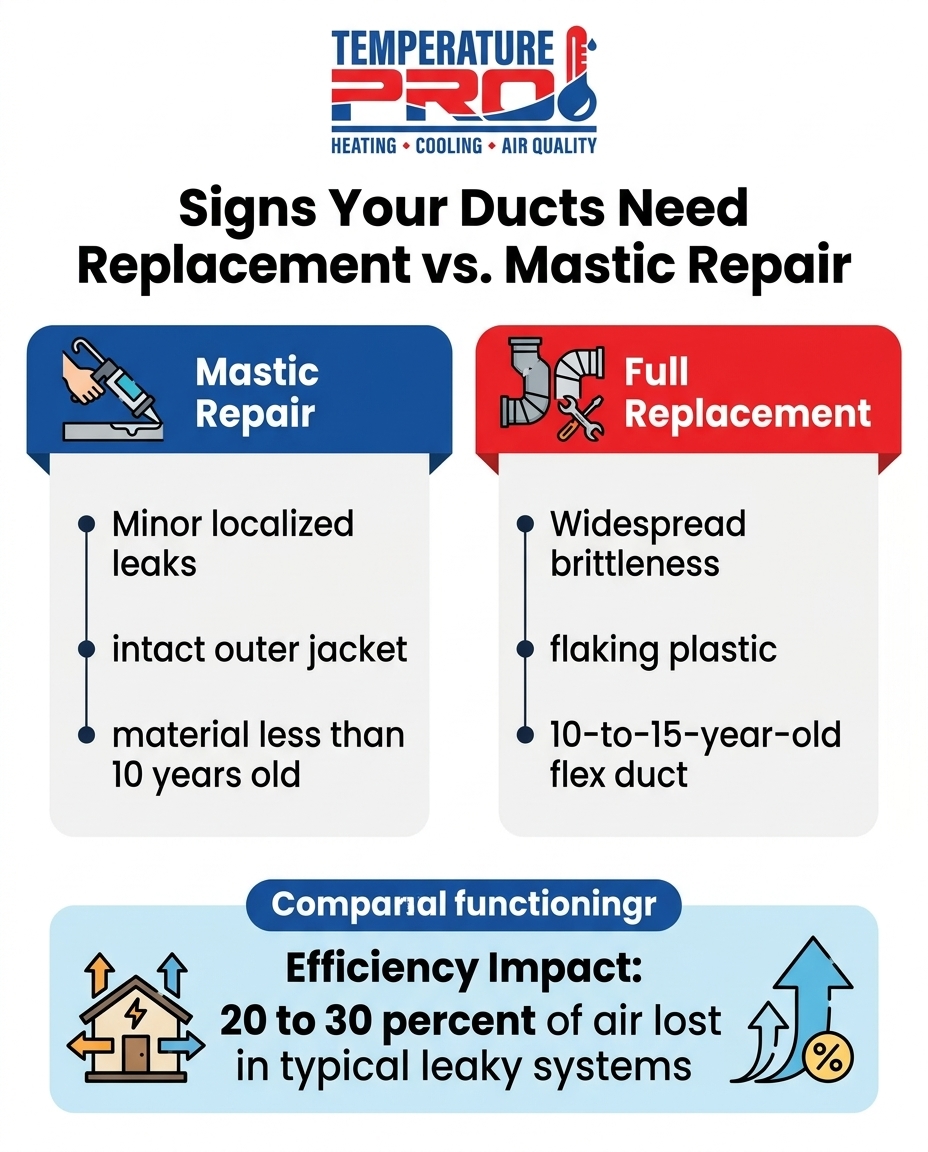
The choice between mastic repair and full duct replacement comes down to the plastic jacket. Mastic suits minor, localized leaks on a pliable, intact jacket; replacement is needed for widespread brittleness, collapsed runs or crumbling 10-to-15-year-old flex duct.
Evaluating your options requires looking objectively at the physical condition of your materials and the long-term efficiency goals for your home. This side-by-side breakdown highlights the key differences between a professional mastic patch and a complete system replacement, framing the decision purely around structural integrity and performance.
• Ideal Use Case — Professional Mastic Repair: Minor, localized leaks at joints, plenums, or boots. — Full Ductwork Replacement: Widespread structural failure, severe brittleness, or collapsed runs.
• Material Condition Required — Professional Mastic Repair: Outer jacket must be pliable, intact, and free of widespread dry rot. — Full Ductwork Replacement: Required when dealing with crumbling, 10-to-15-year-old flex duct.
• Long-Term Efficiency Impact — Professional Mastic Repair: Restores original efficiency to newer, fundamentally sound systems. — Full Ductwork Replacement: Establishes a brand-new, highly insulated baseline for aging homes.
• Professional Process — Professional Mastic Repair: Cleaning the surface, applying mesh tape, and painting on fibered mastic sealant. — Full Ductwork Replacement: Removing old materials, installing modern insulated flex duct, and securing all new connections.
The choice ultimately comes down to the health of the plastic jacket. If the foundation is solid, a repair makes sense. If the foundation is crumbling, replacement is the only logical path forward.
Whether your system requires a few minor mastic patches or a complete ductwork overhaul, maintaining that newly restored efficiency requires proactive attention. The attic environment is harsh, and even the most durable materials benefit from regular professional oversight.
Evaluating your ductwork during the early fall / September pre-heating transition is the most effective way to prevent mid-winter emergencies. When one of our professional technicians inspects your system before the heavy heating demands begin, they can identify small separations at the plenum or tiny punctures in the flex duct before they escalate into massive energy drains. Catching a minor leak early means it can be sealed with mastic quickly, preserving the integrity of the run and keeping your utility usage predictable.
Proactive care extends beyond just looking at the physical tubes. A comprehensive approach involves checking the static pressure of the entire system, ensuring that the blower motor is pushing the correct volume of air, and verifying that the temperature rise across the heat exchanger is within manufacturer specifications. Enrolling in a professional HVAC maintenance plan guarantees that these critical checks are performed on a consistent schedule. Regular maintenance ensures that your entire system—from the furnace burner to the furthest supply vent—operates in perfect harmony, keeping your home comfortable regardless of how cold the outside temperature drops.
A professional duct assessment includes inspecting the duct runs, testing the pliability of the outer jackets and measuring airflow to living spaces. An honest assessment never pushes full replacement when a professional mastic patch will suffice.
Making the call between repair and replacement can feel daunting, especially when the ductwork is hidden away in a dark, cramped attic. This is where the integrity of your service provider becomes your most valuable asset. At TemperaturePro Baton Rouge, working with our veteran-owned and family-operated team means you receive the same level of discipline, accountability, and straight-shooting honesty that military service demands.
A comprehensive, transparent evaluation process removes the guesswork from the equation. Our professional technicians will physically inspect the duct runs, test the pliability of the outer jackets, and measure the airflow reaching your living spaces. We will show you exactly what we find. If a run of 10-to-15-year-old flex duct crumbles to the touch, we will explain the physics of why mastic cannot adhere to it, providing a clear, logical reason for a replacement recommendation.
Conversely, an honest assessment will never push for full replacement if a professional mastic patch will suffice. If the materials are sound and the leak is localized, our reliable technicians will recommend the repair, seal the system, and help you get the maximum possible lifespan out of your existing equipment. This transparent approach prioritizes your long-term comfort and efficiency over unnecessary overhauls, giving you complete confidence in the health of your home.
Have ductwork evaluated during the early fall, September pre-heating transition, before the furnace has to run continuously, rather than waiting until you feel a draft or notice a spike in utility usage.
The window to prepare your home for the shifting seasons is narrow. Acting during the early fall / September pre-heating transition ensures that your system is thoroughly evaluated and optimized before the furnace is forced to run continuously. Do not wait until you feel a draft or notice a spike in your utility usage to address the hidden infrastructure in your attic.
If you suspect your system is losing heated air to the attic, schedule a professional evaluation with TemperaturePro Baton Rouge to determine the true condition of your ductwork. By taking action now, you secure a clear, non-monetary framework for evaluating duct degradation to confidently choose between a mastic patch or full replacement. Ensure your home is ready to keep you warm, efficient, and comfortable all winter long.
When should ductwork be replaced entirely?
Ductwork should be replaced when the outer vapor barrier becomes brittle, flakes apart, or when the inner wire helix collapses. This level of physical degradation typically occurs after a decade or more of exposure to extreme attic heat, at which point the materials can no longer hold a seal or maintain proper airflow.
Is it better to repair or replace leaky ductwork?
The better option depends entirely on the physical condition of the existing materials. If the duct jacket is pliable and the damage is confined to a few small joints, a professional repair is highly effective. However, if the plastic is crumbling and severely aged, replacement is the only way to reliably restore system efficiency.
How long does mastic sealant last on minor duct leaks?
When applied correctly by a professional to an intact, properly prepared duct surface, high-quality fibered mastic can last for the remaining lifespan of the ductwork itself. It cures into a flexible, rubbery seal that expands and contracts with temperature changes without drying out or peeling away.
Does sealing ductwork really help improve winter heating efficiency?
Yes, sealing ductwork has a massive impact on heating efficiency. By closing gaps and tears, you ensure that the pressurized warm air generated by your furnace is delivered directly to your living spaces rather than being blown into the unconditioned attic.
How does extreme attic heat cause flexible ductwork to fail?
Intense radiant heat causes the chemical plasticizers in the duct's outer jacket to evaporate over time. As these compounds break down, the once-flexible plastic becomes rigid and brittle, eventually cracking and exposing the inner insulation to moisture and air pressure blowouts.
Go With Experience