5 min read
Fall HVAC Troubleshooting: Why Your Heater Smells Like Burning Dust on Startup
Is that burning dust smell normal? Read our home maintenance tips and troubleshooting to see why heating startup odors happen and when to call a professional.


Heating a century-old home shouldn't mean replacing its beautiful wavy glass. Learn how specialized airflow adjustments combat the massive thermal loss of original windows as fall temperatures drop.
Adapting your HVAC strategy for historic Baton Rouge homes with original single-pane windows is one of the most complex mechanical challenges local property owners face. The thermostat clicks on, warm air blows from the vents, yet a distinct, creeping chill still settles across the living room every evening. This is the reality of living in a beautifully preserved century-old home. While the architectural charm of these neighborhoods is undeniable, the massive thermal loss and drafts pulling through original wavy glass create a constant battle between historical preservation and modern comfort.
As the September pre-heating season transition begins, the focus shifts from fighting the sweltering Louisiana summer to preparing for unpredictable cold snaps. The decision point is clear: you want to maintain a consistently warm, comfortable indoor environment as temperatures drop, but you absolutely do not want to rip out historically significant glass just to achieve it. Solving this requires a specialized approach to your HVAC system. At TemperaturePro Baton Rouge, we've helped countless local homeowners overcome this hurdle by treating their historic house as a unique thermal environment rather than a standard modern build.
To properly heat an older home, you first have to understand exactly how it loses heat. Original single-pane glass offers almost zero resistance to thermal transfer. In building science terms, this resistance is measured as an R-value. While a modern, insulated double-pane window might boast an R-value of 3 or higher, original single-pane glass sits at an R-value of roughly 1. This means the glass itself acts as a bridge, constantly bleeding your expensive indoor heat out into the cold night air.
Many homeowners spend their weekends meticulously applying fresh weatherstripping and caulking around the window sashes. While sealing physical air gaps is a critical first step for any property, our technicians consistently find that it cannot overcome the inherent heat transfer of the glass pane itself. The thermal loss through original single-pane glass creates a continuous drain on your heating load that no amount of caulk will fix.
• Window Sashes & Frames — Primary Heat Loss Mechanism: Physical air infiltration (drafts) — Standard Mitigation: Weatherstripping and caulking — HVAC Impact: Increases the volume of cold air the system must heat
• Single-Pane Glass — Primary Heat Loss Mechanism: Direct thermal transfer (conduction) — Standard Mitigation: Window films or storm windows — HVAC Impact: Causes continuous heat bleed, requiring longer heating cycles
• Window Perimeters — Primary Heat Loss Mechanism: Radiant cold effect — Standard Mitigation: Heavy drapery or targeted airflow — HVAC Impact: Creates cold pockets that make the room feel chilly despite warm ambient air
Heat transfer in a historic home involves more than just cold air blowing through a crack. The U-factor of a window measures how well it prevents heat from escaping. Original glass has an exceptionally high U-factor, meaning heat escapes rapidly. Furthermore, these windows create a phenomenon known as radiant cold. Even if your heating system warms the ambient air in the center of the room to 72 degrees, sitting near a large, cold pane of glass will make your body feel chilly as your own body heat radiates toward the cold surface. Upgrading your heating systems requires compensating for this radiant asymmetry so the entire room feels comfortable.
If you hire a contractor who uses out-of-the-box HVAC sizing formulas, they will likely install a system that completely fails your historic home. Standard load calculations rely heavily on modern insulation assumptions—tight building envelopes, double-pane argon-filled windows, and heavily insulated attics. In our experience working across Baton Rouge's historic districts, applying these modern formulas to older homes is a recipe for disaster.
To properly size a unit for a home with original glass, our team uses a strict ACCA Manual J calculation. This is a rigorous, mathematical assessment of the home's exact thermal envelope. Because TemperaturePro Baton Rouge is a veteran-owned company, working with our team means you benefit from a deep commitment to precision, discipline, and exactness in performing these load calculations, contrasting sharply with competitors who might just guess based on square footage or automatically oversize the unit.
A common, misguided solution to drafty windows is simply installing the biggest furnace or heat pump available. We see this pattern often, and it creates severe mechanical and comfort issues:
1. Short-Cycling: An oversized unit blasts the house with heat and shuts off entirely too fast. It satisfies the thermostat in the hallway before the warm air ever reaches the drafty window perimeters.
2. Uneven Heating: Because the system doesn't run long enough to properly mix the air, interior rooms become sweltering while exterior rooms remain freezing.
3. Increased Mechanical Wear: Starting and stopping is the most stressful part of an HVAC system's operation. Short-cycling burns out motors and compressors years before their time.
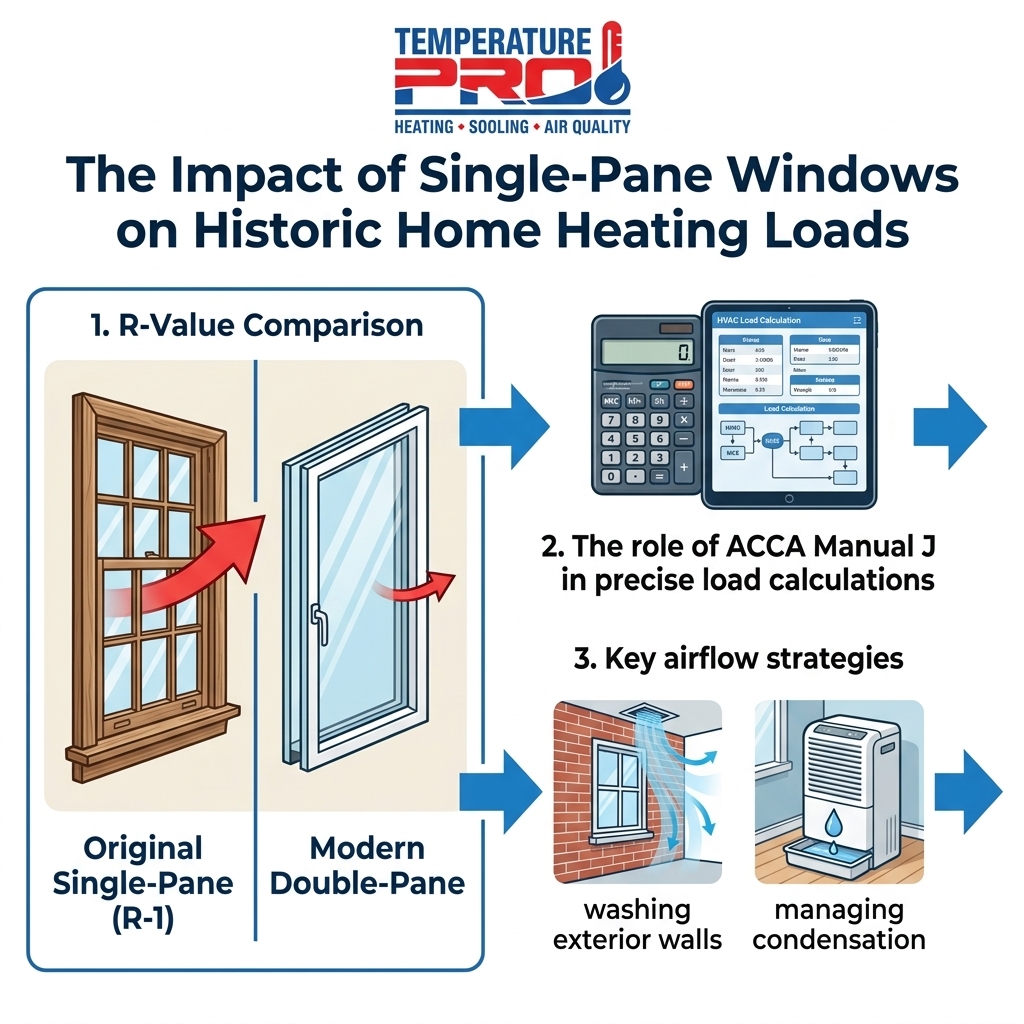
Once the system is properly sized, the next hurdle is delivering the air exactly where it needs to go. You cannot simply dump warm air into the center of a room and expect it to combat the thermal bleed of century-old glass. Instead, our professionals use targeted airflow strategies to manage high-loss areas.
The Problem: Large original windows create a continuous downdraft of cold air that pools across the floor, making the lower half of the room uncomfortably cold.
The Cause: As warm room air touches the cold glass, it cools rapidly, becomes heavier, and sinks to the floor. This convective loop pulls more warm air against the glass, accelerating heat loss.
The Solution: The most effective strategy we recommend is "washing" the exterior walls and windows with warm air. By carefully positioning floor or low-wall registers directly under the historic windows, the HVAC system pushes a gentle curtain of warm air up against the glass. This intercepts the cold downdraft and creates a thermal barrier. However, adjusting register placement and airflow velocity must be done with extreme care to avoid drying out or damaging delicate historic plaster and original woodwork. Managing these airflow dynamics is a critical component of your home's overall indoor air quality and comfort profile.
Baton Rouge's unique climate presents an additional challenge. Our extreme high humidity, combined with occasional sharp winter freezes, creates the perfect environment for severe window condensation. When warm, humid indoor air hits a freezing single-pane window, the moisture instantly condenses into water droplets. If left unchecked, this sweating glass will rot historic wooden window sills and peel original paint. The specialized airflow strategies our team implements keep air moving constantly across the glass, preventing moisture from settling and protecting the architectural integrity of the window frames.
Homeowners in areas like the Garden District or Spanish Town know that local historic preservation guidelines are strict. You cannot simply knock holes in plaster walls for new ductwork or mount unsightly equipment on the front elevation of the house. Our golden rule of historic HVAC retrofitting at TemperaturePro is that the mechanical system must adapt to the house, rather than forcing the house to adapt to the system.
Achieving modern comfort without invasive destruction requires creative engineering. Our technicians often route flexible, insulated ductwork through tight crawlspaces or utilize high-velocity mini-duct systems that snake through existing wall cavities without requiring major demolition. Just as you might focus on reducing cooling costs without sacrificing comfort during the brutal summer months, winter requires its own delicate balance of performance and preservation. The goal is a system that remains entirely invisible while delivering precise, reliable heat to every corner of the property.
The transition from summer to fall is a narrow window. Waiting until the first hard freeze to test your heating system is a gamble, especially in an older home where a breakdown means immediate and severe thermal loss. The September pre-heating season transition is the ideal time for our team to evaluate your ductwork and system staging before unpredictable late-fall temperature drops arrive.
A comprehensive professional assessment for a historic home involves several critical checks:
• Testing the Reversing Valve: For heat pumps, ensuring the system smoothly transitions from cooling to heating mode without hesitation or mechanical grinding.
• Ductwork Integrity Checks: Historic ductwork, often retrofitted decades ago, is notorious for hidden leaks. Leaky ducts in unconditioned attics or crawlspaces will severely exacerbate window drafts inside the living space.
• Airflow Balancing: Measuring the cubic feet per minute (CFM) of air reaching the exterior rooms to ensure the windows are being properly "washed" with warm air.
• Safety Inspections: For gas furnaces, verifying that the heat exchanger is intact and venting properly, as older homes can be particularly vulnerable to carbon monoxide buildup if chimneys or flues are unlined.
Scheduling a proactive tune-up for your air conditioning and heating infrastructure ensures your equipment is calibrated to handle the specific thermal load of your property long before the winter chill sets in.
Our team compensates for drafty windows by "washing" the glass with warm air. This involves placing supply registers directly under or near the windows to create a thermal curtain that intercepts cold downdrafts. Additionally, ensuring the blower motor is set to the correct speed helps mix the room air thoroughly without creating uncomfortable wind-chill effects.
A Manual J calculation is a precise mathematical formula used to determine the exact heating and cooling load of a building. For historic homes, we heavily modify this calculation to account for the exact R-value of single-pane glass, the lack of wall cavity insulation, and the specific air infiltration rates of older construction methods.
You heat a historic home safely by using non-invasive retrofitting techniques and carefully managing airflow velocity. Our professionals route ductwork through existing chases, crawlspaces, or attics to avoid cutting original plaster. We also manage indoor humidity levels to ensure warm air doesn't cause condensation that could rot original wood finishes.
Yes, modern central heating can absolutely be installed in a 100-year-old house. The process requires specialized equipment, such as slim-duct systems or variable-speed heat pumps, which can be adapted to fit the home's unique footprint without violating historic preservation guidelines.
High indoor humidity causes single-pane windows to sweat profusely when outside temperatures drop to freezing. Because the glass offers no insulation, the warm, moist indoor air condenses immediately upon contact, which can lead to water pooling on sills and eventual wood rot if proper airflow isn't maintained.
Modern comfort is entirely possible without compromising the historical architecture that makes your property special. By relying on specialized Manual J sizing, precise airflow strategies, and a deep understanding of how original glass behaves, you can eliminate cold spots and protect your home from winter moisture. Don't wait for the first freeze to discover your system is struggling against the drafts. Schedule a professional assessment with TemperaturePro Baton Rouge early in the fall to ensure your heating strategy is perfectly calibrated for your historic home.
Go With Experience