5 min read
Fall HVAC Troubleshooting: Why Your Heater Smells Like Burning Dust on Startup
Is that burning dust smell normal? Read our home maintenance tips and troubleshooting to see why heating startup odors happen and when to call a professional.


That initial blast of musty air at startup isn't your imagination. Find out what causes dirty sock syndrome in late summer and how to permanently eliminate it.
Are you constantly asking yourself, "Why does my vents smell like mildew when the AC first kicks on?" If you are dealing with this frustrating issue right as the kids head back to school, you are not alone. In our years of servicing HVAC systems across Baton Rouge, our team at TemperaturePro frequently responds to calls about this exact issue. Turning on your air conditioner only to be hit with a blast of musty, sour air that fades after a few minutes is a highly common experience in our area. It is a jarring sensory experience that often leaves homeowners wondering if their indoor air is safe to breathe.
For comprehensive solutions, explore our Indoor Air Quality services or enroll in an AC Maintenance Plan.
Here is the thing: that smell is not just your imagination, and it is not something that will simply go away on its own. The odor originates deep within your HVAC system's internal components, specifically in the dark, damp areas where moisture naturally collects during the cooling process. While the smell itself is a major nuisance, it actually points to a systemic moisture management issue inside your ductwork and air handler.
Many homeowners try to ignore the initial blast of musty air because it typically dissipates after the system has been running for a few minutes. However, the temporary relief is deceptive. The biological contaminants causing the odor are still present inside your equipment. Treating this issue requires a professional indoor air quality assessment rather than a quick spray of household air freshener. Understanding exactly what is happening inside your system is the first step toward breathing clean, fresh air again.
The musty odor you smell at startup is commonly referred to in the HVAC industry as dirty sock syndrome. This descriptive term refers directly to the buildup of mold, mildew, and bacteria on the indoor evaporator coil of your air conditioning system. When these biological contaminants thrive in the dark, damp environment of your air handler, they off-gas odors that smell exactly like a gym bag full of dirty, wet socks.
To understand why this happens, you have to look at how your AC system actually cools your home. The evaporator coil is a critical component located inside your indoor air handler. Its job is to remove both heat and humidity from the indoor air. As warm air blows over the freezing-cold refrigerant lines within the coil, moisture from the air condenses on the cold metal. This process naturally produces gallons of liquid condensate every single day during the heavy cooling season.
Because your air handler is dark and constantly damp, it creates the perfect incubator for biological growth. Airborne microbes—which are naturally present in every home—get pulled into the return vents and eventually bypass the air filter, landing directly on the wet aluminum fins of the evaporator coil. Once there, they mix with the constant moisture and begin to multiply. The mildew smell you notice is actually the off-gassing of these biological contaminants thriving on the coil. It is important to note that this is a symptom of a dirty, contaminated coil, not merely a dirty air filter, which means it requires targeted, professional intervention to resolve.
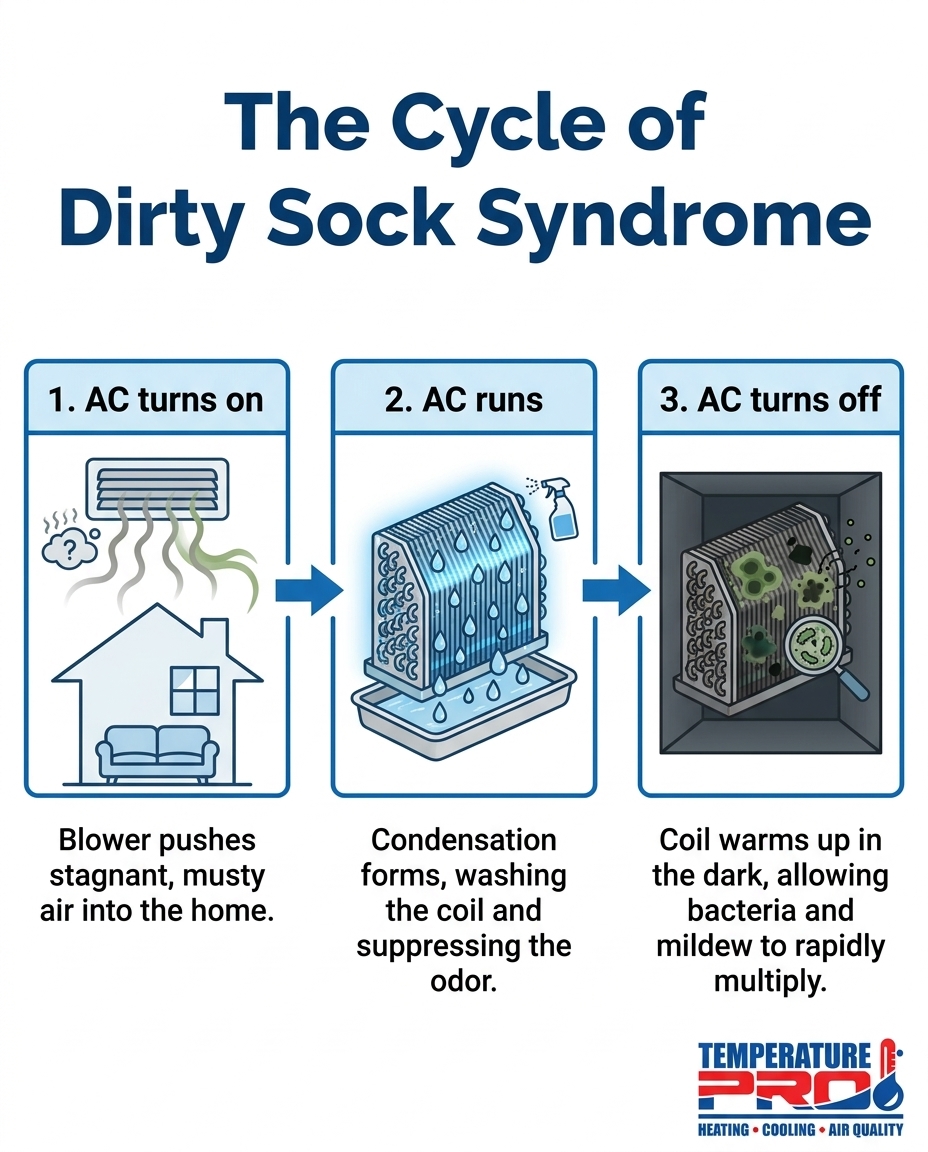
One of the most confusing aspects of dirty sock syndrome is the timing. Homeowners frequently ask why the smell is so overpowering when the system starts, only to vanish five minutes later. The answer lies in the physics of how moisture accumulates during the system's off-cycle.
When your air conditioner shuts off after reaching the desired temperature, the evaporator coil does not instantly dry out. Instead, it remains wet and slowly warms up to room temperature. This warm, dark, and wet environment is the absolute ideal condition for rapid bacterial growth. The microbes that were somewhat dormant during the freezing-cold cooling cycle suddenly wake up and begin multiplying rapidly, releasing a concentrated cloud of odorous gases that sit stagnant inside the air handler.
When the thermostat calls for cooling again, the blower motor is the first component to kick on. It immediately forcefully pushes that stagnant, microbe-heavy air resting on the coil directly into your ductwork and out through your living space vents. This is why you get hit with a concentrated blast of mildew odor right at startup.
• System is Off — Coil Condition: Warm, wet, and dark. Microbes multiply rapidly. — Odor Result: Odor gases accumulate inside the air handler.
• System First Kicks On — Coil Condition: Blower pushes accumulated gases into vents. — Odor Result: Strong, concentrated blast of mildew smell.
• System Actively Running — Coil Condition: Coil becomes freezing cold; heavy condensation forms. — Odor Result: Odor fades as bacteria go dormant and water washes the coil.
After a few minutes of running, the coil gets ice cold again. Fresh condensation begins forming rapidly, which acts like a continuous rinse cycle, washing the active bacteria down the drain line and temporarily suppressing the odor. However, the fading smell does not mean the problem is gone; the bacteria are simply dormant, waiting for the next off-cycle to begin multiplying again.
The local climate plays a massive role in the severity of dirty sock syndrome. Indoor mold and mildew generally thrive when relative humidity exceeds 60 percent. During periods of August late-summer humidity, the moisture load on residential AC systems is at its absolute peak. The air is so thick with moisture that your system has to work overtime just to wring the water out of the indoor air.
Living with a subtropical climate means that your HVAC system is fighting a constant battle against moisture. During the peak of late summer, the extreme heat causes your system to run frequently, but the sheer volume of humidity means the evaporator coil never has a chance to fully dry out between cycles. This constant wet state creates a permanent breeding ground for bacteria.
This relentless moisture load is exactly why the startup smell often appears suddenly late in the cooling season. The coil has been wet for months, and the biological growth has finally reached a critical mass where the off-gassing becomes noticeable inside the living spaces. Regional climate realities make proactive moisture management essential for maintaining healthy indoor air quality.
While dirty sock syndrome on the evaporator coil is the most common culprit for startup odors, it is not the only potential source of moisture-related smells in your HVAC system. Biological growth can take hold anywhere that stagnant water is allowed to accumulate.
• Clogged condensate drain lines: If the PVC pipe that carries water away from your AC gets backed up with algae or debris, stagnant water will sit in the line and emit a foul odor.
• Overflowing drip pans: The pan beneath your evaporator coil catches condensation. If it rusts, tilts, or fails to drain, the standing water becomes a swampy breeding ground.
• Ductwork contamination: If humidity levels remain high for too long, biological growth can spread from the coil directly into the surrounding fiberglass ductwork.
• Wet or severely clogged filters: A filter that has become damp due to high humidity or system malfunctions can harbor mildew, acting as a secondary source of the odor.
We see these secondary issues constantly. In fact, our team recently helped a local homeowner who experienced a related drainage crisis during the late summer. Just four days after Hurricane Ida, their system stopped working properly due to condensation drip pan issues. We dispatched a technician within three hours of the call, quickly diagnosing the problem, providing clear advice, and installing a needed part to get the system running efficiently again. Complex drainage issues require prompt attention to prevent water damage and severe indoor air quality degradation. If you suspect your system is suffering from broader drainage or mechanical failures, our Air Conditioning Services can provide the comprehensive diagnostics needed to pinpoint the exact source.
When faced with a foul odor coming from the vents, many homeowners reach for the easiest available solution: aerosol air fresheners, vent sprays, or scented candles. Unfortunately, these products only mask the odor temporarily. Worse, they introduce unnecessary volatile organic compounds (VOCs) into your indoor air, which can further irritate respiratory systems.
If you realize the smell is coming from the evaporator coil, you might be tempted to open the air handler and clean it yourself. This is highly discouraged. Evaporator coils are incredibly fragile components. They are made of hundreds of thin aluminum fins spaced tightly together to maximize surface area. These fins are easily crushed or bent flat by improper brushing, stiff bristles, or heavy-handed scrubbing. Once the fins are crushed, airflow is severely restricted, which can cause the entire system to freeze over and fail.
Furthermore, using harsh household chemicals or bleach on an aluminum coil can cause rapid corrosion, leading to microscopic refrigerant leaks that destroy the equipment. Accessing the evaporator coil also involves navigating high-voltage electrical components and delicate, pressurized refrigerant lines. Attempting this work without proper training can easily result in injury, voided manufacturer warranties, and expensive permanent damage to the system. You can learn more about how professionals handle this delicate process when they safely clean evaporator coils using specialized, non-destructive methods.
Eliminating the startup mildew blast requires a disciplined, professional approach that addresses the root cause rather than just treating the symptoms. As a veteran-owned company, our TemperaturePro Baton Rouge team brings the discipline and accountability required to diagnose these issues correctly. We pride ourselves on implementing long-term, systemic solutions rather than cutting corners with temporary fixes.
The first step in permanently resolving dirty sock syndrome is a professional deep cleaning of the evaporator coil. Technicians use specialized, non-acidic foaming cleansers designed specifically for HVAC applications. These foaming agents expand deep into the tight spaces between the aluminum fins, safely lifting biological matter, dirt, and debris out of the coil without damaging the fragile metal. Once the foam has neutralized the contaminants, it is safely rinsed away, leaving the coil completely sterilized and restoring optimal airflow.
While a deep cleaning removes the existing bacteria, it does not stop new microbes from entering the system tomorrow. This is where UV germicidal lights come into play. Installed directly inside the air handler, these powerful ultraviolet lights shine continuously on the evaporator coil and drain pan.
UV light works by physically altering the DNA of mold, mildew, and bacteria, effectively sterilizing them and stopping them from reproducing—even during the humid off-cycles when the coil is warm and wet. By maintaining a continuously sterile environment, UV lights act as the ultimate preventative cure, ensuring that the biological growth cannot return. This systemic approach to indoor air quality is far superior to relying on quick-fix sprays, but it strictly requires professional installation to ensure correct placement, optimal exposure angles, and safe electrical integration.
The musty smell is caused by moisture and bacteria sitting on the evaporator coil while the system is off. During the off-cycle, the dark, warm, and wet environment allows microbes to multiply rapidly. When the fan turns on, it blows this stagnant, odor-filled air into your home before fresh condensation can wash the coil clean.
In our experience, the most effective fix involves a professional deep-cleaning of the evaporator coil using specialized foaming chemicals that safely remove the biological buildup. To prevent the issue from recurring, our technicians highly recommend installing a UV germicidal light over the coil. The UV light continuously sterilizes the area, stopping bacteria from returning.
While it is often just a nuisance, prolonged exposure to biological growth can aggravate allergies or asthma in sensitive individuals. Breathing in musty air daily is not ideal for respiratory health. It is best to have a professional assess the system to ensure there is no significant mold growth spreading into the ductwork.
A clean filter improves airflow and catches dust, but it cannot remove biological growth that has already formed on the evaporator coil. The microbes causing the odor are bypassing the filter or growing directly on the wet components inside the air handler. Filter changes are an important preventative measure, but they are not a cure for existing dirty sock syndrome.
As the AC runs, the evaporator coil gets extremely cold and produces heavy condensation. This condensation acts like a continuous rinse cycle, temporarily washing away the odorous bacteria and suppressing the smell. However, the microbes remain in the system and will begin off-gassing again as soon as the system shuts off and warms up.
If you are still wondering, "Why does my vents smell like mildew when the AC first kicks on?", the answer is clear: your system is suffering from biological growth on the evaporator coil. That initial startup blast is a definitive sign that moisture and microbes have taken hold inside your air handler. Fortunately, you do not have to wait out the late-summer heat suffering through compromised indoor air quality.
With the right professional intervention, this frustrating issue can be permanently resolved. Deep chemical cleaning combined with advanced UV light technology will sterilize your system and keep your indoor air fresh and healthy. Do not let dirty sock syndrome dictate your home's comfort. Schedule a professional inspection today or enroll in an AC Maintenance Plan to ensure your system stays clean, efficient, and odor-free year-round.
Go With Experience