Addressing Inadequate Return Air Scenarios in Renovated French Settlement Properties
Addressing Inadequate Return Air Scenarios in Renovated French Settlement Properties
Flipped homes look great but often hide starved HVAC returns behind new drywall. Discover how objective static pressure testing reveals these hidden bottlenecks before winter heating season begins.
The Hidden Airflow Problem in Beautifully Flipped Homes
Addressing inadequate return air scenarios in renovated French Settlement properties is a critical step if your newly purchased, beautifully updated home is already struggling to maintain a comfortable temperature. Your air conditioner is running nonstop, but the living room still feels warm and the blower motor sounds like it is working overtime. You bought the home for its stunning aesthetic updates—the fresh drywall, the luxury vinyl plank flooring, the modern fixtures—but those visual improvements frequently mask severe mechanical flaws that lurk just out of sight.
The aesthetic versus mechanical clash: General contractors and flippers excel at modernizing older floor plans. They knock down walls to create spacious, open-concept living areas that look incredible in real estate photos. However, aesthetic updates often completely overlook the mechanical requirements of the house. Specifically, they ignore the heating and cooling system's fundamental need to "breathe." An HVAC system is a closed loop; it can only push out as much conditioned air as it pulls in through the return vents.
When walls are removed or hallways are reconfigured, the original return air pathways are frequently blocked, downsized, or eliminated entirely. The result is a beautifully finished house with an HVAC system that is suffocating behind the walls. Discovering these hidden restrictions before the heavy winter heating load begins is vital to preventing sudden, catastrophic system failure. Proper indoor air quality and airflow depend entirely on a balanced ductwork design, and ignoring the return side of the equation will quickly turn your dream home into a remarkably uncomfortable living space.
How Open-Concept Renovations Disrupt Original Return Air Pathways
Older homes in French Settlement properties were originally designed with very specific, compartmentalized floor plans. The original HVAC ductwork was carefully calculated to match those specific rooms, with return air grilles strategically placed to pull stale air back to the central air handler. When a renovation team comes in to modernize the space, their primary goal is visual flow, not airflow.
The disappearing return vent: Removing interior walls to create an open-concept layout frequently means tearing out the very wall cavities that housed the original return ducts. While contractors are usually careful to leave the ceiling supply vents intact—or even extend them to cover the newly expanded room—the return side is frequently ignored or hastily capped off. The system is left trying to pull enough air for a 2,000-square-foot open space through a single, undersized hallway grille.
Standard home inspections rarely catch this issue. A standard inspector checks for visual elements and basic functionality: they turn the thermostat down, verify that cold air comes out of the vents, and check the box. They do not perform complex airflow volume (CFM) calculations to ensure the system is balanced. This is a typical pattern we see in the field. During a recent spring tune-up on a multi-unit A/C system in a renovated property, a technician cleaned the coils and immediately identified potential issues stemming from restricted airflow, documenting the parts needing future attention before the stressed system ultimately failed.
• Original Compartmentalized Floor Plan — Supply Air Focus: Sized for specific, closed-off rooms. — Return Air Focus: Dedicated pathways in central hallways or shared walls. — Typical HVAC Impact: Balanced airflow, assuming original design was followed.
• Open-Concept Renovation (Flipped) — Supply Air Focus: Extended or left intact to cover larger open areas. — Return Air Focus: Often removed, blocked, or reduced when walls are knocked down. — Typical HVAC Impact: Severe return air starvation, high static pressure, and blower motor strain.
The Imbalance Between Supply and Return
The vacuum effect: The basic principle of any forced-air system is equilibrium. An HVAC unit can only supply as much air as it pulls in. When the return pathways are restricted or eliminated by renovation work, the system creates a massive vacuum effect in the remaining return ducts. The blower motor is forced to work exponentially harder, fighting against the physical resistance of trying to pull a massive volume of air through a straw. This imbalance not only ruins your daily comfort but actively degrades the mechanical components inside your air handler.
Recognizing the Symptoms of a Starved HVAC System
If you recently moved into a renovated home and suspect the airflow was compromised during construction, your house will give you several warning signs. Recognizing these symptoms early allows you to seek professional HVAC troubleshooting before the equipment suffers permanent damage from static pressure bottlenecks.
Watch and listen for these clear indicators of a starved return:
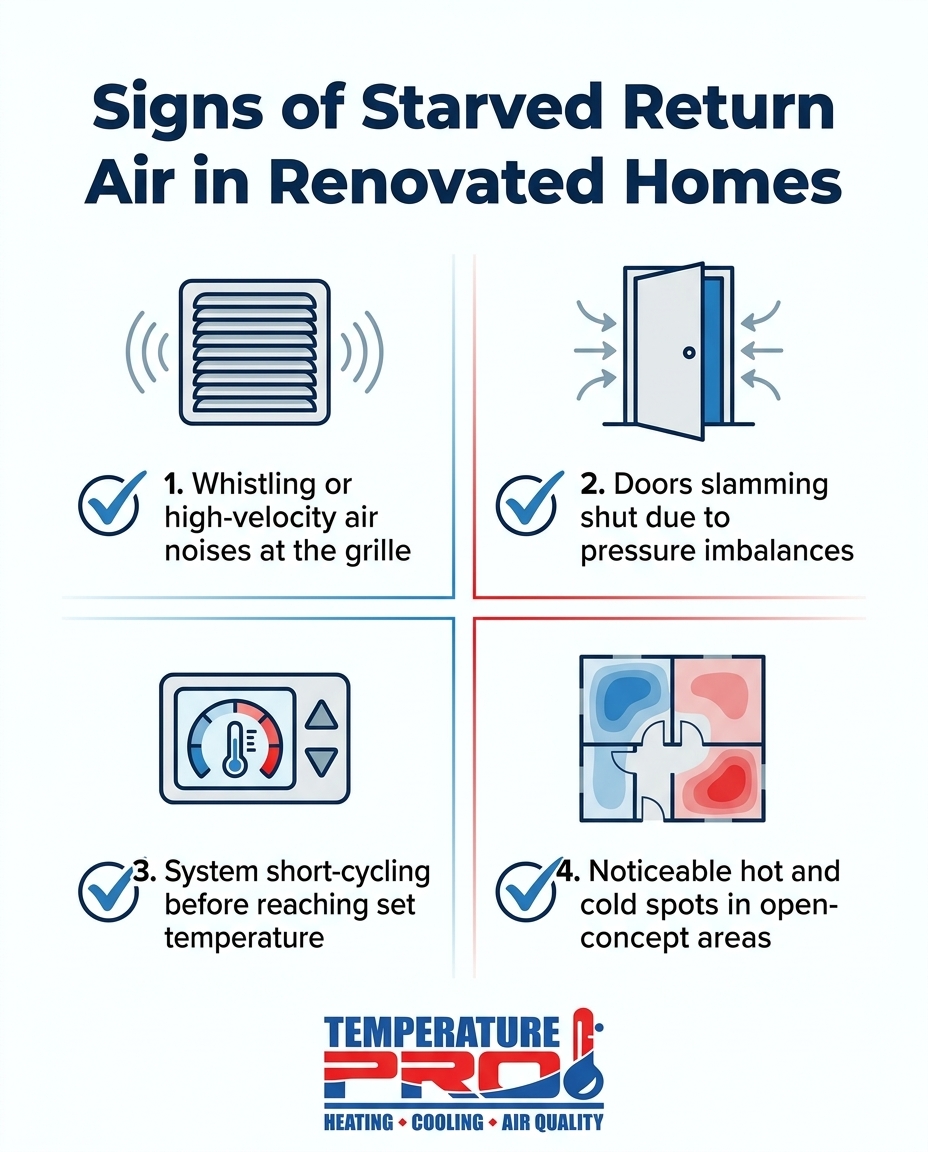
• Auditory warnings (whistling noises): A high-pitched whistling or roaring sound coming from your return grilles is a primary red flag. This happens because the blower motor is desperately trying to pull the required volume of air through an opening that is far too small, drastically increasing the air velocity and creating noise.
• Physical pressure imbalances: If interior doors slam shut on their own when the HVAC system kicks on, or if you feel a strong resistance when trying to open a door against the airflow, you have a severe pressure imbalance caused by inadequate return pathways.
• Noticeable hot and cold spots: In an open-concept space, the temperature should be relatively uniform. If you notice drastic temperature swings from one side of the room to the other, the system is failing to pull the ambient air back across the heat exchanger or evaporator coil effectively.
• Operational short-cycling: If your system turns on, runs for only a few minutes, and shuts off before the room reaches the temperature set on the thermostat, it is short-cycling. This is often a safety mechanism triggering because the internal components are overheating due to a lack of airflow.
• Excessive dust accumulation: A starved return will pull air from anywhere it can, including unconditioned attics, crawlspaces, or wall cavities if there are any gaps in the ductwork, leading to rapid dust buildup on the grille.
If you notice more than one of these symptoms, changing your air filter will not solve the problem. The issue is structural, and it requires professional intervention.
Signs of Starved Return Air in Renovated Homes
The Physics of Airflow: Understanding Static Pressure Bottlenecks
To truly understand why a starved return is so destructive, we have to look at the physics of airflow and the concept of Total External Static Pressure (TESP). You can think of TESP as the "blood pressure" of your heating and cooling system. It measures the total resistance that the blower motor must overcome to circulate air throughout your home. When a renovation removes a return duct, that resistance skyrockets, creating severe static pressure bottlenecks.
Pushing past manufacturer limits: Every modern HVAC system is engineered to operate within a very specific static pressure range, typically around 0.5 inches of water column (in. w.c.). When returns are undersized or blocked, the static pressure can easily double. Modern Variable Speed (ECM) blower motors are programmed to maintain a specific airflow volume. When they sense this increased resistance, they automatically ramp up their RPMs to try and overcome the bottleneck. This causes the motor to consume significantly more electricity, run dangerously hot, and ultimately suffer from accelerated premature failure.
Proper airflow is a precise science, not a guessing game. Industry standards, such as the Air Conditioning Contractors of America (ACCA) Manual D, dictate exactly how large ductwork must be to support the required cubic feet per minute (CFM) of air. When contractors ignore these standards during a flip, they doom the equipment. The long-term damage to the blower motor and the compressor is inevitable if the system is left to operate outside of its designed parameters. For homeowners dealing with these invisible restrictions, diagnosing ductwork bottlenecks with specialized tools is the only way to uncover the true extent of the problem.
Why the September Pre-Heating Season is Critical for Diagnostics
Timing is everything when dealing with compromised airflow. Discovering a starved return in the middle of a severe weather event is a recipe for disaster, which is why the September pre-heating season is the optimal time to evaluate system performance. The transition period in early fall provides a critical window to address these mechanical flaws before extreme demands hit the equipment.
The danger of fluctuating temperatures: South Louisiana's fluctuating fall and winter temperatures severely punish short-cycling systems. During this season, the weather can swing from warm and humid in the afternoon to sharply cold overnight. Your HVAC system must pivot quickly, cycling efficiently to maintain comfort. A starved return makes this impossible. Because the system cannot pull enough air across the heat exchanger, the internal temperature of the furnace rises rapidly.
If the heat exchanger gets too hot, the system's high-limit safety switch will trip, shutting the unit down entirely to prevent a fire hazard. This creates a vicious cycle of the system turning on, overheating, shutting down, and turning back on again. Sudden cold snaps combined with restricted airflow can lead to catastrophic blower motor failure precisely when heating is needed most. A starved return isn't just an efficiency issue that raises your utility bills; it is a major operational risk. Securing a routine HVAC maintenance plan and scheduling a comprehensive evaluation during this pre-heating window ensures your system is actually capable of handling the winter load.
Objective Diagnostics: Protecting Your New Aesthetic Finishes
One of the biggest fears homeowners have when they discover a hidden ductwork issue is that fixing it will require tearing up their brand new drywall, ruining their fresh paint, or ripping out their new ceilings. This is where professional, data-driven diagnostics stand in stark contrast to the standard "trial and error" methods used by general contractors.
Data over guesswork: True HVAC technical experts do not need to punch holes in your walls to determine if your return air is restricted. Instead, technicians use specialized digital manometers to measure static pressure directly at the equipment. By taking objective readings of the pressure on both the supply side and the return side of the air handler, they can pinpoint exactly where the static pressure bottlenecks are occurring. This objective testing separates licensed professionals from general contractors who focus only on visual aesthetics.
This data-driven approach provides a clear, cost-effective path forward. In one instance during a summer heatwave, a technician assessed an AC that was not functioning correctly, ran comprehensive static pressure tests, and explained the airflow problem thoroughly to the homeowner. The technician even determined that a stressed component was still under warranty—scheduling a return visit to install the part without relying on any destructive guesswork. By adhering to strict safety and licensing standards, professionals can often retrofit additional return ductwork through closets, utility rooms, or attics, solving the problem without destroying your new finishes or resorting to dangerous DIY duct modifications.
Frequently Asked Questions About Restricted HVAC Return Air
What happens if an HVAC return is too small?
When an HVAC return is too small, the entire system starves for air, which drastically increases the static pressure inside the ductwork. This extreme resistance forces the blower motor to work much harder than intended, leading to overheating, higher energy consumption, and premature failure. Ultimately, it results in poor temperature control, leaving your home with noticeable hot and cold spots despite the system running constantly.
How do I know if my return air is restricted?
The most common signs of restricted return air are auditory and physical. You will likely hear loud whistling or roaring noises coming from the return grille as the system struggles to pull air through a tight space. Additionally, you may notice interior doors slamming shut on their own due to pressure imbalances, excessive dust buildup near the grille, and an HVAC unit that short-cycles before the room reaches the desired temperature.
Can you add a return vent to an existing system?
Yes, professionals can often retrofit additional return vents to an existing system to alleviate airflow bottlenecks. This process involves calculating the required cubic feet per minute (CFM) of air and routing new ductwork through accessible areas like attics, basements, or closets. It requires careful, objective calculation by a licensed technician to ensure the new return actually balances the system without causing further pressure issues.
Why is my HVAC return so loud after a home renovation?
Home renovations, particularly open-concept remodels in French Settlement properties, often involve removing interior walls that previously housed return air pathways. When these pathways are eliminated, the system is forced to pull the exact same volume of air through fewer or smaller remaining grilles. This creates high-velocity air movement, which manifests as a loud, rushing, or whistling noise at the vent.
Does a starved return affect my heating system differently than my AC?
While a starved return damages both heating and cooling functions, it affects the heating system in a uniquely dangerous way. Restricted airflow prevents the system from moving enough air across the heat exchanger to cool the metal down. This causes the heat exchanger to rapidly overheat, which triggers the system's high-limit safety switch, resulting in rapid short-cycling and potential long-term damage to the furnace components.
Secure Your Home's Comfort Before Winter Arrives
Moving into a beautifully renovated home should be an exciting milestone, not the beginning of a frustrating battle with your thermostat. Addressing airflow bottlenecks and starved returns early is the only way to protect the mechanical integrity of your system and ensure your daily comfort. The aesthetic updates to your home are complete, but ensuring the hidden mechanical systems can actually breathe is just as important.
With the September pre-heating season upon us, now is the time to act before sudden cold snaps push your stressed blower motor past its breaking point. Do not wait for a complete system failure on a freezing night to find out your ductwork is restricted. Schedule professional heating system services today for a comprehensive, data-driven evaluation. By diagnosing the issue with objective static pressure testing, you can understand exactly why your home has airflow issues, fix the problem without destructive guesswork, and enjoy true peace of mind before winter arrives.
Thank you! Your submission has been received!
Oops! Something went wrong while submitting the form.
Tired of massive energy spikes during sudden winter freezes? See how modern inverter-driven heat pumps maintain efficiency without relying on energy-hogging resistive strips.
Lower autumn sun angles can directly hit your thermostat, causing false high readings that force your AC to run non-stop. See whether relocating the device or adding remote sensors is the best fix.
That alarming odor on the first chilly morning is usually just summer dust burning off your heat strips. Find out how long it should last before you need to worry.