Why We See a Spike in Clogged Condensate Drain Lines During August Thunderstorm Season
Why We See a Spike in Clogged Condensate Drain Lines During August Thunderstorm Season
Peak late-summer humidity forces your AC to work overtime, triggering rapid algae blooms in the drip pan. Recognizing a sluggish condensate line early prevents unexpected overflows that ruin your ceiling.
The Late-Summer Threat to Your AC System
As the sweltering heat collides with heavy afternoon downpours and families transition back to school, our technicians at TemperaturePro Baton Rouge are frequently asked exactly why we see a spike in clogged condensate drain lines during August thunderstorm season. The sudden shift in weather patterns forces your cooling equipment to work overtime, pulling massive amounts of moisture from the indoor air while running nearly non-stop. If you are noticing water pooling around your indoor unit, explore our air conditioning services or secure your system's reliability with an AC maintenance plan.
The transition into late summer brings intense weather patterns that test the limits of your home's cooling infrastructure. While your system may have performed flawlessly through June and July, the sheer volume of condensation produced in late summer creates a unique set of challenges. We consistently see accelerated algae blooms and stubborn blockages forming in drain pans and PVC lines right as the humidity reaches its peak.
The critical decision point: Recognizing these warning signs early is the key to protecting your property. When you catch a sluggish drain line before it completely stops flowing, engaging our professional team saves you from the massive headache of an overflow. Waiting until the system shuts down—or worse, until water starts dripping through your ceiling—turns a routine maintenance visit into an emergency repair situation. Now is the time to pay close attention to how your system is handling the excess moisture.
How Extreme Humidity Overwhelms Condensate Systems
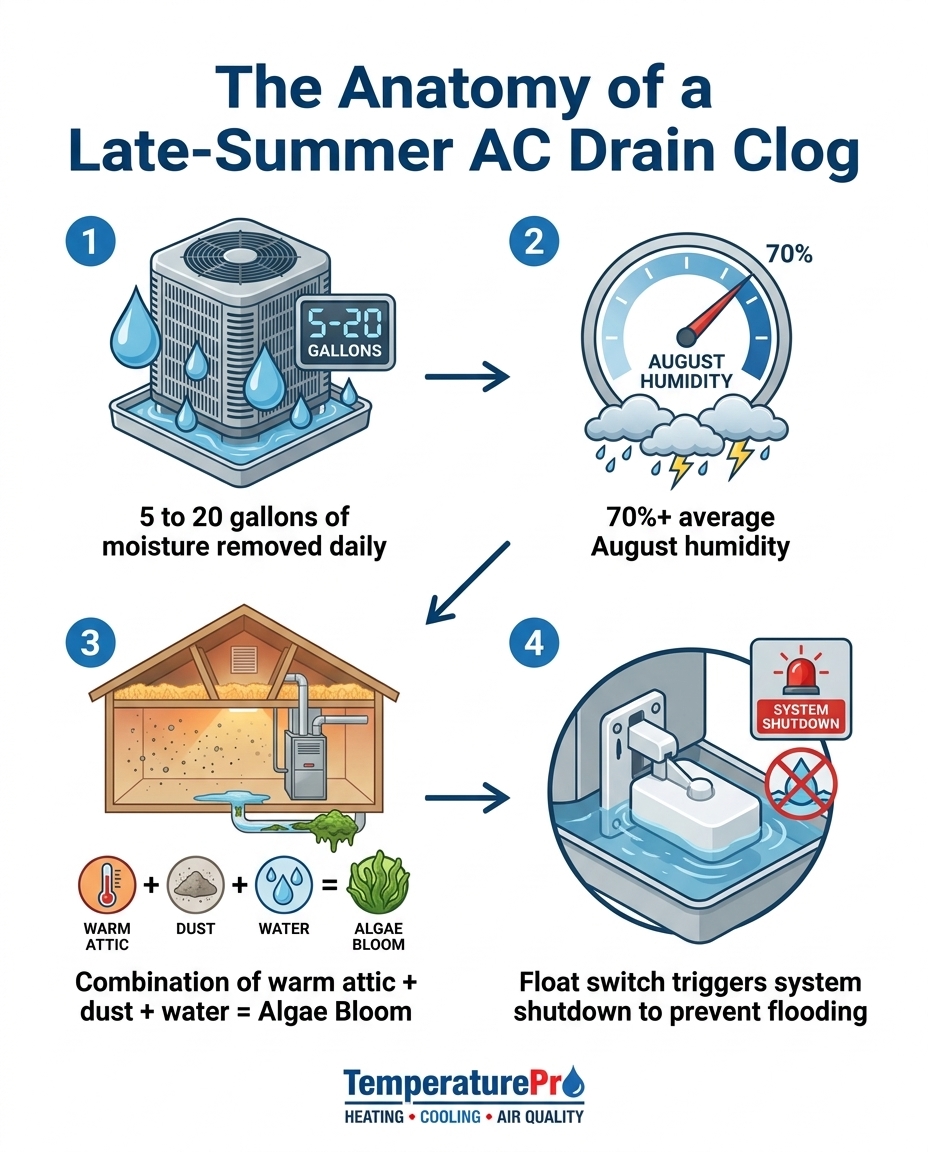
To understand the sudden influx of clogs, you first have to look at the sheer volume of water your system handles daily. In our years of servicing cooling equipment across Baton Rouge, our team typically sees that extreme heat paired with 70% or higher relative humidity is the norm during the late summer. Frequent August severe thunderstorms only add to the moisture load in the air, forcing your system to act as a heavy-duty dehumidifier just to keep your living spaces comfortable.
The 20-Gallon Daily Workload
During peak summer humidity, an average central AC unit removes anywhere from 5 to 20 gallons of moisture from the air every single day. This condensation drips off the cold evaporator coils into a shallow drain pan, where it is supposed to flow smoothly out of your house through a narrow PVC pipe.
Because the weather demands continuous system usage, your AC rarely cycles off for long. This means the drain pan never gets a chance to dry out. It remains a constant, shallow pool of standing water.
"When an AC unit runs continuously during high-humidity weeks, the constant flow of water puts immense mechanical strain on drain lines that might already be partially restricted by summer dust buildup."
When a sudden, massive influx of condensation occurs during a particularly humid thunderstorm, a sluggish drain line simply cannot keep up with the volume. The water backs up, the pan fills to the brim, and the mechanical strain on the entire drainage system reaches a breaking point.
The Perfect Breeding Ground for Algae and Biological Growth
The connection between excess moisture and clogged lines comes down to basic biology. Your air conditioning system creates a microclimate that certain organisms absolutely love, and late summer provides the exact ingredients needed for rapid multiplication.
Problem: The Dark, Warm, and Damp Environment
Algae, mold, and biological particulates thrive in dark, warm, and damp environments. Your indoor air handler—especially the drain pan sitting beneath the evaporator coil—fits this description perfectly. Throughout the earlier summer months, normal household dust, pet dander, and airborne particles bypass your air filter and settle into the drain pan.
Cause: The Creation of Biological Sludge
When that accumulated summer dust mixes with the constant flow of water, it creates a thick, nutrient-rich sludge. This sludge feeds biological growth. While a small amount of algae might grow in June or July, the continuous moisture and elevated temperatures of late summer trigger a sudden, rapid algae bloom. The algae multiplies exponentially, binding with the sludge to form a gelatinous mass that, as our maintenance crews often discover, easily clogs a three-quarter-inch PVC pipe.
Solution: Proactive Professional Intervention
Clearing this biological buildup requires more than just removing the visible water. It requires treating the source of the growth and improving the overall cleanliness of your system. Pairing routine drain line maintenance with comprehensive indoor air quality solutions helps reduce the amount of dust and particulates that make it into the drain pan in the first place, starving the algae of its food source.
• System Run Time — Early Summer Impact: Moderate cycling allows the pan to dry out occasionally. — Late Summer (August) Impact: Continuous running keeps the pan permanently wet.
• Condensation Volume — Early Summer Impact: 5-10 gallons of water removed daily. — Late Summer (August) Impact: Up to 20 gallons of water removed daily.
• Biological Growth — Early Summer Impact: Slow accumulation of dust and minor algae. — Late Summer (August) Impact: Rapid, exponential algae blooms forming thick sludge.
The Hidden Danger for Attic HVAC Installations
While a clogged drain line is an inconvenience for a unit located in a garage or utility closet, our team typically sees the most severe property damage risks in Baton Rouge homes with attic HVAC installations. When an attic unit overflows, the consequences are immediate and often catastrophic for the living spaces directly below.
The Threat of Ceiling Damage
If the primary drain line clogs with algae, the water level in the pan rises rapidly. Most modern systems are equipped with a secondary drain pan and a float switch. The float switch is a safety device designed to trip and shut off the AC entirely if the water gets too high. While this leaves your house uncomfortably hot, it is meant to prevent a flood.
However, if the secondary drain fails, or if the float switch malfunctions due to the same thick sludge clogging the line, the water has nowhere to go but over the edge of the pan. This results in gallons of water soaking into your attic insulation, bleeding through your ceiling drywall, and potentially collapsing the ceiling into your living room.
Real-World Impact
One Baton Rouge homeowner faced this exact threat late in the summer, right before the back-to-school rush. They needed an emergency AC repair on a Friday afternoon when their upstairs cooling system shut down completely due to a tripped safety switch. Because they called at the first sign of trouble, our technician arrived right away, identified the severe algae blockage, and safely repaired the upstairs cooling system. The upstairs was cool and the ceiling was saved just in time for their expected out-of-town company.
The Anatomy of a Late-Summer AC Drain Clog
Early Warning Signs of a Sluggish Drain Line
The best way to prevent water damage and unexpected system shutdowns is to recognize the early warning signs of a restriction before it becomes a complete blockage. Your air conditioning system will usually give you a few subtle hints that it is struggling to drain properly.
What Your System is Trying to Tell You
Based on the hundreds of emergency calls we field each August, homeowners who ignore these symptoms often find themselves dealing with the severe risks of skipping AC maintenance right when they need their cooling the most. Keep an eye out for these critical indicators:
• Pooling water or unusual moisture: If you notice damp spots, standing water, or water stains around the base of your indoor air handler, the primary drain is likely backing up.
• Musty, moldy odors: A drain pan full of stagnant water and algae will circulate a distinct "dirty sock" or musty smell through your air vents every time the blower motor kicks on.
• The AC system repeatedly shutting itself off: If your thermostat is set to cool but the system turns off after only a few minutes, the float switch is likely tripping due to high water levels, then resetting as the water slowly trickles down.
• Gurgling or bubbling sounds: When a line is partially clogged, the water struggles to pass through the restriction, creating a noticeable gurgling noise near the indoor unit.
• Water dripping from the exterior secondary pipe: If you see water dripping from the secondary drain pipe (often located above a window outside), your primary line is completely blocked.
Why DIY Drain Clearing is a Costly Mistake
When faced with a clogged drain line, it is tempting to look for a quick, do-it-yourself fix. However, attempting to clear a severe late-summer algae blockage without professional tools and training often causes more harm than good. We strongly recommend professional intervention over DIY fixes because our technicians frequently have to repair the damage caused by improper vacuum use.
The Dangers of Improper Vacuum Use
Many online forums suggest using a standard wet/dry shop vacuum to suck the clog out from the outside pipe. While a vacuum is part of a professional's toolkit, using one improperly can severely damage sensitive components. If the suction is applied incorrectly, it can damage the delicate fins of the evaporator coil, dislodge the drain pan, or break the PVC connections, leading to hidden leaks inside your walls.
The Risk of Harsh Chemicals
Another common mistake is pouring harsh chemicals, such as concentrated bleach or industrial drain cleaners, down the condensate line. These chemicals are highly corrosive. They can rapidly degrade the PVC pipes, eat away at the glue holding the joints together, and cause the pipe to crack. Furthermore, using unauthorized chemicals in your HVAC system will almost certainly void your manufacturer's warranty.
The bottom line: Clearing a stubborn, gelatinous algae bloom from an HVAC system requires specialized knowledge of how the primary and secondary drain systems interact. Never attempt to disassemble your drain line or bypass safety switches on your own; this requires a licensed professional to ensure the system drains safely and correctly.
Our Disciplined Process for Safely Clearing Blockages
When you call in the experts to handle a sluggish or blocked drain line, you are investing in a long-term solution rather than a temporary patch. Working with a veteran-owned company like TemperaturePro Baton Rouge means you benefit from our disciplined, rigorous operational standards. We do not just clear the immediate blockage; we ensure the entire drainage system is structurally sound and protected against future algae blooms.
How We Restore Your System's Flow
1. Comprehensive System Inspection: We begin by thoroughly inspecting both the primary and secondary drain lines, the drain pan, and the float switch. We check for micro-cracks in the PVC and ensure the pan is properly sloped so water doesn't pool unnecessarily.
2. Safe, Professional-Grade Clearing: Using specialized, high-suction equipment and professional-grade, non-corrosive clearing agents, we break down the stubborn algae sludge. We ensure the entire length of the pipe is cleared, not just the immediate surface clog.
3. Safety Switch Verification: We test the float switch and all secondary safety mechanisms to guarantee they will trigger correctly if a problem ever arises in the future, protecting your home from water damage.
4. Preventative Treatments: Finally, we apply specialized, time-release biological treatments to the drain pan. These treatments actively fight algae growth, keeping the line clear for the remainder of the cooling season.
By making this process a regular part of your AC maintenance plan, you eliminate the stress of sudden late-summer breakdowns and keep your system running at peak efficiency.
Protect Your Ceiling from Late-Summer AC Overflows
As the intense heat and humidity of thunderstorm season continue to put pressure on your cooling system, proactive care is your best defense. You do not have to wait for a tripped float switch or a stained ceiling to take action.
Professional clearing is safe, thorough, and highly effective at stopping algae blooms in their tracks. By addressing sluggish drain lines early, you ensure your home stays cool and your property remains protected. If you suspect your system is struggling to drain, reach out to our TemperaturePro Baton Rouge experts today to schedule a comprehensive inspection and regain your peace of mind.
Frequently Asked Questions
Why does my AC drain line keep clogging in the summer?
Your AC drain line clogs frequently in the summer due to the massive amount of condensation the system produces combined with rapid algae growth. The constant flow of water keeps the drain pan permanently wet, creating a perfect environment for biological sludge to form. As dust mixes with this moisture in the peak heat, it forms a thick blockage that stops water from flowing through the pipe.
How do you know if your AC condensate line is clogged?
The most common sign of a clogged condensate line is your AC system unexpectedly shutting itself off to prevent flooding. You may also notice water pooling around the indoor unit, a musty smell coming from your vents, or gurgling sounds near the air handler. If you see water dripping from the secondary drain pipe outside your home, your primary line is completely blocked.
What happens if my AC drain line is clogged?
If your AC drain line is clogged, the water will back up into the drain pan until it triggers the float switch, which shuts down the entire cooling system. If the safety switch fails or the secondary drain is also blocked, the water will overflow the pan. This overflow can quickly lead to severe water damage in your home, especially if the unit is located in an attic.
Can a clogged AC drain line cause water damage?
Yes, a clogged AC drain line can cause catastrophic water damage, particularly in attic installations. When the drain pan overflows, the water soaks into the surrounding insulation and drywall. This can lead to ruined ceilings, structural rot, and extensive mold growth inside your walls if not addressed immediately.
How often should a condensate drain line be professionally cleared in Louisiana?
In Louisiana's highly humid climate, a condensate drain line should be professionally cleared and treated at least twice a year. Scheduling a clearing during your spring tune-up prepares the system for the heavy summer workload, while a late-summer check ensures algae hasn't built up during the most intense heat. Regular maintenance prevents sudden clogs from catching you off guard.
Will pouring bleach down my AC drain line prevent algae?
Pouring bleach down your AC drain line is not recommended and can actually cause significant damage to your system. Bleach is highly corrosive and can degrade the PVC piping and the glue holding the joints together, leading to hidden leaks. Instead, professionals use specialized, non-corrosive biological treatments that safely prevent algae without voiding your equipment's warranty.
Thank you! Your submission has been received!
Oops! Something went wrong while submitting the form.
When the late-summer August sun turns your retail space into an oven, standard RTU calculations fail. Find out how solar heat gain impacts commercial cooling loads.
Discovering a refrigerant leak in late summer forces a tough choice. Use our diagnostic framework to decide if patching an older R-410A system is worth the investment.
Finding a solid block of ice inside your AC during an August heat wave defies logic. We break down the counterintuitive pressure drops that cause freezing and why leak repair is the only solution.