5 min read
Does Closing Curtains Actually Reduce My Cooling Bill in South Louisiana?
When late-summer heat hits, your AC works overtime to keep up. We break down the science of solar heat gain so you can decide if blackout curtains are worth it.


Finding a solid block of ice inside your AC during an August heat wave defies logic. We break down the counterintuitive pressure drops that cause freezing and why leak repair is the only solution.
Understanding the physics of refrigerant phase changes: why low Freon makes your coils turn to ice is usually the last thing on your mind until your air conditioner completely freezes over in the middle of summer. Your system is running nonstop, the vents are barely pushing out any air, and the house still feels incredibly warm. You go to check the indoor unit, fully expecting to find a dirty filter or a tripped breaker. Instead, you are met with a bizarre sight: a solid block of ice encasing your system's components.
If you're dealing with a frozen system right now, our team provides expert air conditioning services to safely thaw and repair your unit.
Finding ice inside your home while battling late-summer August heat outside defies basic logic. Most homeowners immediately assume that a lack of "cooling fluid" should result in a system that simply blows hot air, not one that turns into a glacier. The shock of discovering frozen coils while the system blows warm air is a typical pattern we see in the field. To understand this strange phenomenon, you have to look past the surface and understand the core culprit: a refrigerant leak altering the internal pressure of your entire cooling system. Because this is a pressurized chemical process, resolving a frozen coil requires professional diagnostics to solve the root cause, rather than just waiting for the ice to melt.
Before diving into the physics of freezing, we need to clear up a widespread misunderstanding about how air conditioners actually operate. Modern cooling systems utilize a closed-loop design. This means the chemical refrigerant (often referred to generically as Freon) travels in a continuous, sealed circle between your indoor and outdoor units. It absorbs heat from inside your home, carries it outside, releases it, and loops back inside to do it again.
A typical misconception is treating HVAC refrigerant like gasoline in a car. Gasoline is a consumable fuel that burns away as you drive. Refrigerant is completely different—it is never consumed, burned, or "used up" during normal operation. Therefore, if a technician tells you that you have "low Freon," that always indicates a physical leak somewhere in the copper lines, the evaporator coil, or the condenser coil. Understanding this is a critical part of knowing what to do when your AC stops working in summer, because simply adding more refrigerant will never fix the underlying structural failure.
A healthy cooling system never needs a "top-off" or a routine recharge. If your system is fully sealed, the exact same refrigerant that was installed on day one will still be circulating ten years later. Assuming a system just needs a quick recharge only delays necessary repairs and allows the leak to grow worse over time.
• Function — Car Gasoline: Combusted to create mechanical energy. — AC Refrigerant: Circulated to absorb and transfer heat.
• Consumption — Car Gasoline: Burned away during normal use. — AC Refrigerant: Never consumed; changes physical states only.
• Depletion Cause — Car Gasoline: Driving the vehicle. — AC Refrigerant: A physical hole or leak in the closed system.
• Proper Solution — Car Gasoline: Refill the tank at a gas station. — AC Refrigerant: Locate the leak, repair the metal, then recharge.
In many Baton Rouge area homes, we see homeowners frustrated by recurring breakdowns simply because a previous contractor topped off the system instead of addressing the actual breach in the closed loop.
To understand why a lack of refrigerant causes freezing, we have to look at the direct relationship between pressure and temperature. In the world of thermodynamics, these two forces are locked together. When the pressure of a gas drops rapidly, its temperature drops right along with it. This specific pressure loss forces the coil to operate well below its intended temperature range.
Normally, the evaporator coil inside your house operates at roughly 40 degrees Fahrenheit—cold enough to cool the air blowing over it, but safely above the freezing point of water. When refrigerant leaks out of the closed loop, the overall pressure inside the system plummets. This results in pressure drops causing coil temperatures to fall below 32 degrees. Once the metal coil crosses that freezing threshold, the stage is set for a massive buildup of ice.
If the science of HVAC pressure seems abstract, think about a common household item: a can of compressed air used for dusting computer keyboards.
• The resting state: Before you use it, the can sits at room temperature.
• The pressure release: When you hold down the nozzle, you are rapidly releasing the pressurized contents inside.
• The temperature drop: Within seconds of spraying, the metal can feels freezing cold in your hand, and condensation might even form on the outside.
Your air conditioner's evaporator coil undergoes the exact same process when there is a leak. The escaping refrigerant causes a rapid expansion and a sudden loss of pressure inside the copper tubes, turning the entire coil into a freezing cold hazard.
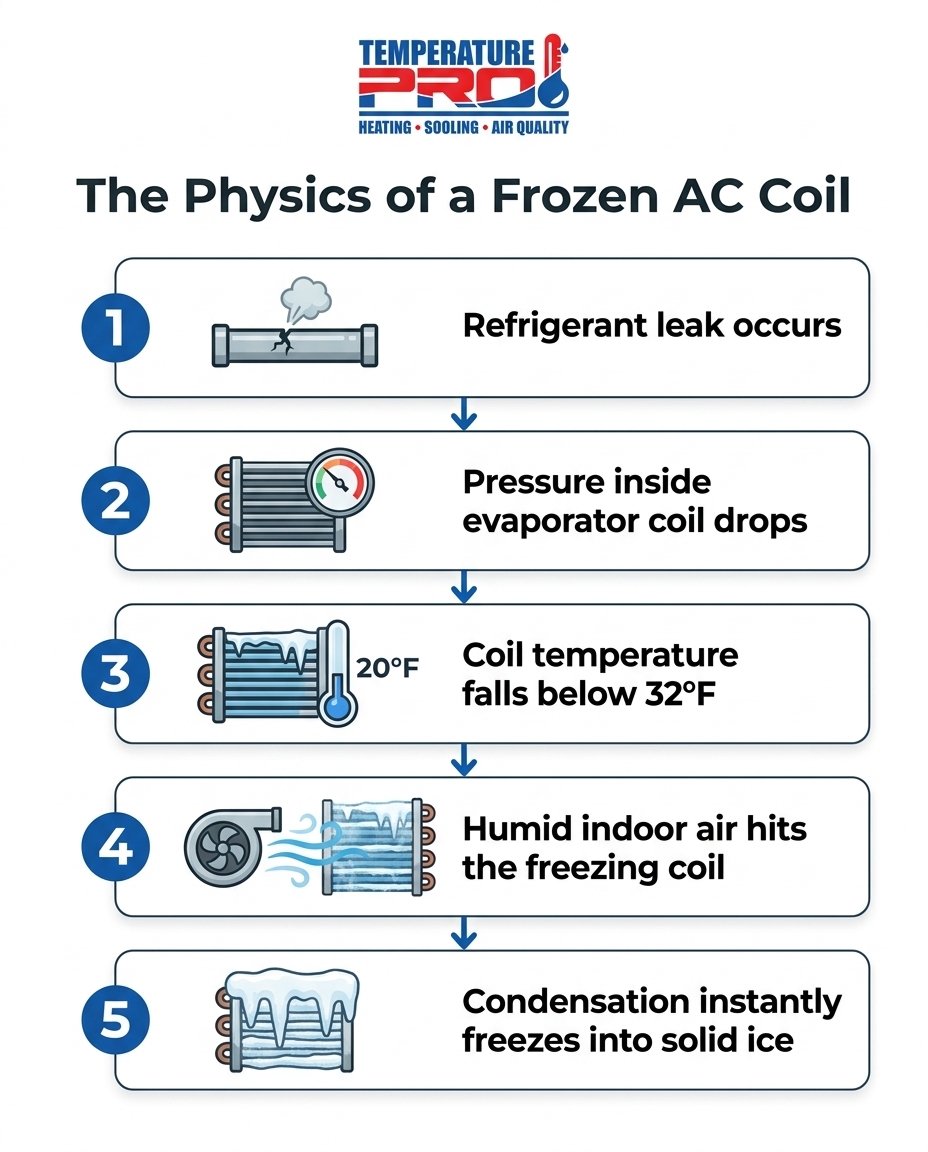
We have established that a leak causes the coil itself to drop below freezing. However, the physical ice has to come from somewhere—refrigerant itself does not turn into ice on the outside of the machine. The ice actually comes from the surrounding air inside your house.
The Problem: As your system runs, the indoor blower fan pulls warm air from your rooms and pushes it across the evaporator coil. In a humid climate, this indoor return air carries a massive amount of water vapor.
The Cause: Under normal conditions, this water vapor condenses into liquid droplets on the cool metal, drips down into a drain pan, and safely flows outside. However, Baton Rouge's notoriously high humidity provides an abundant, continuous moisture load. When the coil is operating below 32 degrees, those liquid droplets never have a chance to drain. They hit the freezing metal and instantly turn to frost.
The Solution: Because the system is desperate to cool the house, the thermostat keeps the unit running continuously. This causes the frost to rapidly compound. Layer upon layer of moisture freezes, eventually forming a solid block of ice that restricts airflow completely. We see this severe compounding effect frequently in Baton Rouge area homes during the most humid months of the year, accelerating the freezing process significantly compared to dry climates.
When a homeowner discovers a frozen system, the most tempting request is to just ask a technician to "fill it back up" so the house can get cool again. Adding refrigerant without finding the leak is a temporary and wasteful band-aid. Because the system is pressurized, the newly added chemical will simply be pushed right back out through the exact same hole. The ice block will inevitably return, often within a matter of days or weeks.
Furthermore, there are strict environmental and regulatory reasons why leaks must be addressed. EPA guidelines mandate responsible handling of refrigerants, as releasing these chemicals into the atmosphere is harmful to the environment. Continually topping off a leaking system is not just bad mechanics; it is an unsustainable practice.
One local homeowner reached out late on a Saturday night right before a hurricane hit. Their system was failing, and instead of just dumping in more refrigerant to get them through the night, a technician tracked down the actual leak, repaired it, and properly recharged the system. The unit was fixed permanently, providing reliable relief before the storm made landfall. This highlights the vital importance of proper HVAC troubleshooting.
Working with a veteran-owned company means you get a commitment to doing the job right the first time, without cutting corners. We refuse to do a disservice to our community by offering a quick-fix "recharge" when we know the system is compromised. Instead, we insist on finding and repairing the actual leak. By utilizing precision diagnostic tools—like electronic leak detectors and UV dye tests—we locate the microscopic breaches in the coils or lines that cause pressure drops causing coil temperatures to fall below 32 degrees. We emphasize permanent solutions over temporary relief because your family's comfort should never rely on a band-aid fix.
If you walk to your indoor unit right now and see ice creeping along the copper lines or covering the evaporator coil, you need to take immediate action to protect the equipment. A technician cannot properly diagnose or repair a leak until the system is completely thawed, so starting the thawing process safely is your top priority.
1. Turn the AC off immediately: Go to your thermostat and switch the cooling setting to "OFF." This stops the compressor from running and halts the continuous freezing cycle.
2. Turn the fan to "ON": Switch the thermostat fan setting from "AUTO" to "ON." This forces the indoor blower to circulate warm, unconditioned air over the frozen coil, which dramatically speeds up the thawing process.
3. Prepare for water runoff: As the ice block melts, it may overwhelm your condensate drain pan. Place towels around the base of the indoor unit to catch any overflow and prevent water damage to your floors or drywall.
4. Check your air filter: While waiting for the thaw, pull out your air filter. If it is severely clogged with dust and debris, it may have contributed to the airflow restriction.
A crucial warning: Never use tools, knives, or scrapers to chip the ice away. The aluminum fins on your evaporator coil are incredibly delicate. Puncturing the coil while trying to remove ice will release all remaining refrigerant and instantly turn a repair job into a full coil replacement. Managing expectations is important here; depending on the severity of the ice buildup during late-summer August heat, a complete thaw can take anywhere from a few hours to a full day. For more guidance on system behavior, review our HVAC FAQs.
Finding ice on your air conditioner is never a quirk of the weather; it is always a symptom of a deeper mechanical issue. Whether it stems from a severe airflow restriction or pressure drops causing coil temperatures to fall below 32 degrees due to a refrigerant leak, professional intervention is required.
The peace of mind that comes with a fully sealed, properly pressurized system is invaluable, especially when the late-summer heat is at its peak. By understanding the physics of refrigerant phase changes: why low Freon makes your coils turn to ice, you are better equipped to make informed decisions about your home's comfort. We strongly encourage proactive care to catch minor pressure anomalies before they turn into major late-summer breakdowns. Scheduling routine AC maintenance ensures your closed-loop system remains intact, efficient, and ready to handle whatever the Louisiana climate throws your way.
Why does low refrigerant cause an AC to freeze?
When refrigerant leaks out of the system, the internal pressure inside the evaporator coil drops significantly. According to the laws of thermodynamics, this drop in pressure forces a corresponding drop in temperature, pushing the coil below 32 degrees and causing condensation to freeze.
Is it normal for an AC to need more freon?
No, it is never normal for an air conditioner to need more refrigerant. Modern cooling systems operate on a closed loop, meaning the chemical is never consumed or burned off. If your system is low, you have a physical leak that requires professional repair.
How long does it take for AC coils to unfreeze?
Depending on the size of the ice block and the ambient temperature inside your home, a complete thaw can take anywhere from 4 to 24 hours. Turning your thermostat fan to the "ON" position while the cooling is turned off will help accelerate the melting process safely.
Can I just add more freon to my AC myself?
No, handling HVAC refrigerant requires specialized training and EPA certification due to the environmental hazards and high-pressure nature of the chemicals. Adding refrigerant without repairing the underlying leak is also a temporary waste of money, as it will simply leak out again.
Where does the ice on my AC actually come from?
The physical ice comes from the water vapor in your home's indoor air. As warm, humid return air blows across the compromised, sub-freezing evaporator coil, the moisture instantly condenses and turns into solid frost, eventually compounding into a block of ice.
Go With Experience