5 min read
Fall HVAC Troubleshooting: Why Your Heater Smells Like Burning Dust on Startup
Is that burning dust smell normal? Read our home maintenance tips and troubleshooting to see why heating startup odors happen and when to call a professional.


Flipping straight from morning heat to afternoon AC strains your system's valves. Waiting just five minutes between modes protects your equipment during fall temperature swings.
Understanding the mechanical stress of switching between heating and cooling on the same day in Louisiana is the first step to protecting your HVAC system when you wake up to a freezing house and return home to a sweltering one. Your furnace kicks on at 6 a.m. to take the chill out of the air, but by 3 p.m., the afternoon sun has turned your living room into an oven. It is incredibly tempting to walk over to the thermostat and immediately flip the switch from "Heat" to "Cool." However, treating your climate control system like a simple light switch can cause severe mechanical strain on delicate internal components like reversing valves and expansion valves.
During the early fall transition (September), this rapid back-and-forth switching forces your equipment to abruptly halt one intense physical process and instantly begin another. Instead of demanding immediate results from the thermostat, homeowners must adopt a disciplined delay protocol to protect their equipment from sudden pressure shocks. Understanding how heat pump systems and traditional split systems handle these transitions is critical to preventing catastrophic failure. Ultimately, proactive care and enrolling in a routine HVAC maintenance plan serve as your best defense against the heavy seasonal wear and tear that comes with our unpredictable weather.
In many parts of the country, the transition from summer to winter is a slow, gradual glide. Here, the meteorological conditions of transitional seasons are far more aggressive. It is entirely common to see morning lows dip into the crisp 50s while afternoon highs surge back into the mid-90s. This rapid environmental change forces your HVAC unit to perform two completely different thermal jobs within a matter of hours. The sheer physics of a 40-degree daily temperature swing means your equipment never truly gets a day off during the early fall.
This specific climate phenomenon makes local systems significantly more susceptible to mechanical wear than those operating in more temperate, predictable regions. In a northern climate, a homeowner might turn their furnace on in October and leave it running untouched until April. In Baton Rouge, your system is undergoing the stress of mode reversal repeatedly throughout the month. This is a daily operational reality, meaning the internal components are constantly expanding and contracting, pressurizing and depressurizing, day after day.
Most homeowners assume that the dead of summer or the freezing depths of winter are the hardest times for an HVAC system. In reality, consistent operation in a single mode is often easier on the machinery than constant cycling and reversing. Here is why fall demands so much more from your equipment:
• Continuous cycling and mode reversal: Summer and winter demand consistent, steady operation in one primary mode, allowing refrigerant pressures to remain relatively stable. Fall demands continuous cycling and complete directional reversals of the refrigerant flow.
• Thermal expansion and contraction: The physical expansion and contraction of metal components due to rapid ambient temperature changes can loosen electrical connections and stress copper fittings.
• Lubrication migration: Refrigerant carries the oil that lubricates the compressor. Rapidly switching modes can disrupt the smooth return of this oil, forcing the compressor to run with inadequate lubrication for brief, damaging periods.
To truly understand why rapid thermostat adjustments are so damaging, it helps to shift your perspective. Stop viewing your air conditioner and furnace as basic household appliances like a toaster or a television, and start treating them as heavy mechanical equipment requiring strict operational discipline. Think of the HVAC compressor and valve system as a vehicle's transmission. You cannot shift a car from reverse to drive while moving at high speeds without destroying the gearbox. The same physical logic applies to your climate control system.
Modern refrigerant systems operate under intense physical pressure. The compressor is essentially a powerful industrial pump, moving chemical refrigerant through a closed loop of copper tubing. Doing this safely requires specific protocols. Working with a veteran-owned company means you get technical guidance rooted in strict discipline and accountability—we believe in following established operational procedures to protect your heavy equipment from premature failure. Protecting this investment requires technical discipline from the homeowner. A little bit of patience at the thermostat prevents expensive, inconvenient emergency repairs in the middle of a Baton Rouge heat wave.
For homes equipped with heat pumps, the unsung hero of the system is the reversing valve. This critical component is responsible for changing the direction of the refrigerant flow, which is what allows the exact same piece of equipment to switch between heating your home and cooling it. Inside this brass valve is a sliding block mechanism that shifts back and forth. When the thermostat calls for a mode change, a small electrical coil (the solenoid) magnetizes, piloting a pressure differential that physically forces the heavy slider to move.
When a signal is sent to switch modes before the system has naturally powered down and rested, that sliding block is forced to move against immense, active pressure. The mechanical strain that occurs when the valve is forced to shift while the compressor is still actively pumping can be devastating. If the valve gets stuck halfway, the system will blow lukewarm air, completely failing to heat or cool the house. Navigating a 40-degree daily temperature swing safely means allowing this valve to shift when the system is at rest, not when it is firing on all cylinders.
While the reversing valve dictates the direction of the refrigerant, the expansion valve regulates its flow and pressure. This valve is equally vulnerable to rapid mode switching.
• Regulating flow: The expansion valve precisely meters the amount of liquid refrigerant entering the evaporator coil based on the current mode and the thermal load of the house.
• Instant recalibration stress: When modes are flipped instantly, the expansion valve is forced to rapidly recalibrate its metering rate to accommodate the sudden change in refrigerant state and direction.
• Risk of failure: Sudden, violent changes in pressure can cause the delicate sensing bulb and internal diaphragm of the expansion valve to stick, freeze up, or fail entirely, starving the compressor of refrigerant.
The most immediate threat of rapid mode switching is the danger of unequalized refrigerant pressure. When an HVAC system shuts off, the high-pressure side of the refrigerant lines (which can reach several hundred PSI) and the low-pressure side need time to naturally balance out. This equalization process does not happen instantly; it takes several minutes for the gas and liquid to settle.
If you immediately flip the thermostat to a new mode, you create a "locked rotor" scenario. The compressor tries to start its motor against a wall of unequalized high pressure, and it physically cannot turn. Because the motor is stalled but still receiving electricity, it draws a massive spike in electrical current. This immense resistance and electrical draw is exactly why breakers trip at your electrical panel when modes are switched too fast. While a tripped breaker is a safety mechanism, the repeated stress of locked rotor amps permanently degrades the internal copper windings of the compressor, eventually leading to a complete electrical short. This is one of the many hidden risks of skipping AC maintenance in Louisiana, as weakened compressors often fail silently over time during the early fall transition (September).
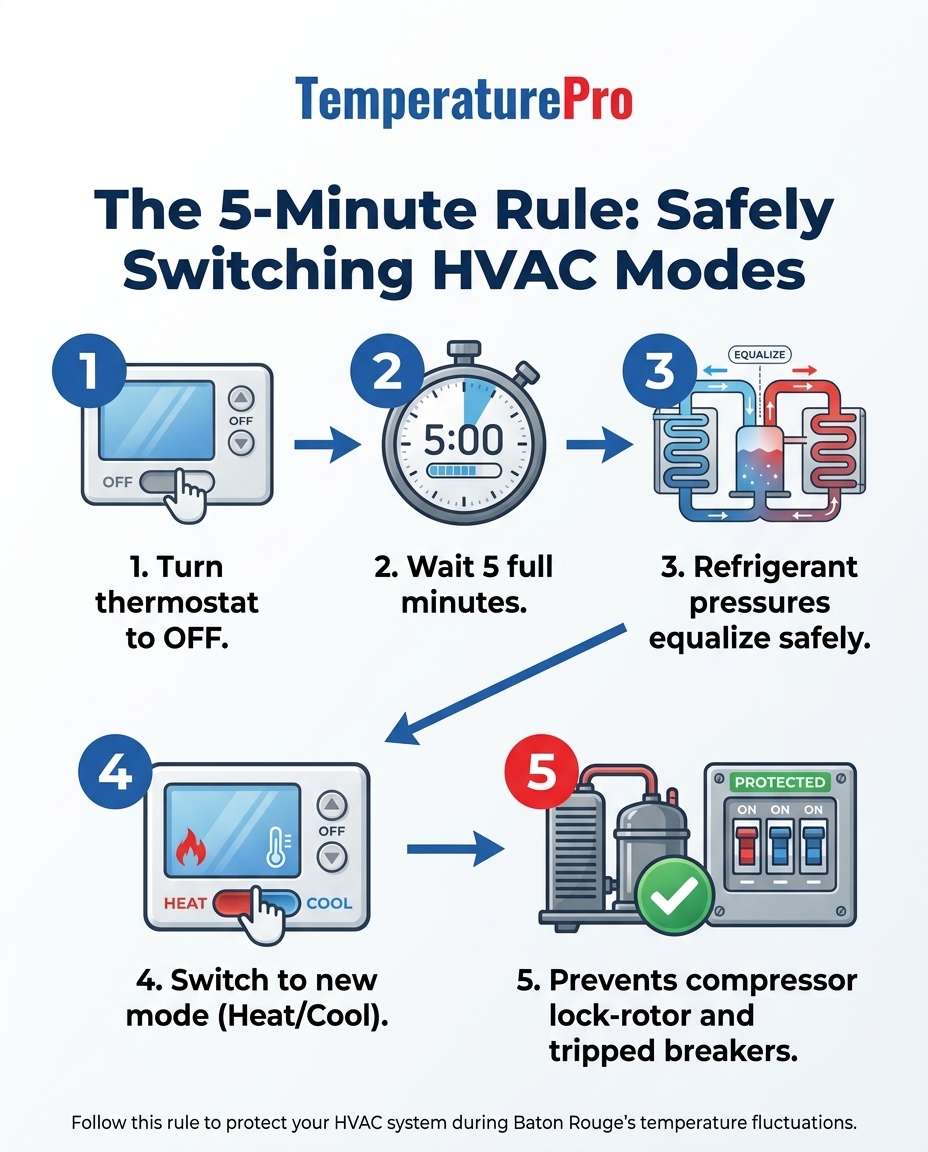
The solution to this complex mechanical problem is surprisingly simple. By adopting a strict operational protocol, you can safely navigate any 40-degree daily temperature swing without putting your heavy machinery at risk. The core actionable advice is known as the 5-Minute Rule: Always turn the thermostat to "Off" and wait a minimum of 5 full minutes before switching to the opposite mode.
This 5-minute window is the exact amount of time required to allow the refrigerant pressures to equalize naturally across the high and low sides of the system. This brief pause allows the reversing valve to shift smoothly without fighting active compressor pressure, and it ensures the compressor motor can start freely without facing the resistance that causes locked rotors. While many modern digital thermostats have a built-in time delay specifically to prevent short-cycling, manually enforcing the 5-minute rule guarantees safety, especially for older or more sensitive systems that might bypass digital safeguards.
1. Step 1: Turn the current mode off completely. Move the thermostat selector from "Heat" or "Cool" to the "Off" position. Ensure the outdoor unit has completely stopped humming.
2. Step 2: Leave the fan on "Auto". Do not force the fan to the "On" position during this transition, as you want the entire system to rest and depressurize.
3. Step 3: Wait 5 minutes for the system to depressurize. Set a timer on your phone if necessary. This is the non-negotiable window for pressure equalization.
4. Step 4: Engage the new mode and set the desired temperature. Move the selector to your new desired mode, set the temperature, and allow the system to initiate its startup sequence naturally.
If you have historically treated your thermostat like a light switch, your system may already be showing signs of mechanical fatigue. It is important to recognize these symptoms early so you can schedule a professional assessment before a minor valve issue turns into a total compressor failure. One common symptom of a stuck reversing valve is a system that blows hot air when set to cool, or vice versa. If the valve slider is jammed halfway, you might also notice a distinct lack of airflow or air that feels completely unconditioned.
Frequently tripped breakers at the electrical panel strongly indicate the compressor is struggling against high pressure and pulling too many amps. Additionally, short cycling (where the unit turns on and off rapidly every few minutes) or strange hissing noises from the outdoor unit require immediate professional attention. We frequently see these issues during seasonal transitions. For example, one Baton Rouge homeowner recently scheduled their first AC tune-up after moving into a new home, noting the system was acting strange during the seasonal shift. A technician performed a thorough cleaning and tune-up, restored proper function, and noted specific items for the system's future health to prevent unexpected breakdowns.
If you notice any of these warning signs, a professional diagnostic is necessary to restore proper air conditioning performance and ensure reliable heating services for the coming winter months.
• Blowing hot air in "Cool" mode — Likely Mechanical Cause: Stuck or failing reversing valve — Recommended Action: Leave system OFF; call for professional diagnostic.
• System trips the circuit breaker — Likely Mechanical Cause: Locked rotor / unequalized pressure — Recommended Action: Do not reset breaker repeatedly; wait 5 mins, if it trips again, call a technician.
• Loud hissing from outdoor unit — Likely Mechanical Cause: Internal pressure bypass / expansion valve issue — Recommended Action: Turn off immediately to prevent compressor damage.
• Short cycling (on/off every 2 mins) — Likely Mechanical Cause: Low refrigerant or pressure control failure — Recommended Action: Requires professional gauge reading and inspection.
How long should you wait to switch from heat to AC?
You should always wait a minimum of 5 full minutes before switching from heating to cooling. This brief pause allows the highly pressurized refrigerant in your system to equalize naturally. Failing to wait can force the compressor to start against immense resistance, leading to electrical spikes and mechanical wear.
Can switching from heat to AC break my unit?
Yes, switching back and forth instantly can cause severe damage over time. It places extreme mechanical strain on the reversing valve and the expansion valve, and can cause the compressor to stall. Following a strict delay protocol protects these expensive components from premature failure.
Why did my AC trip the breaker when I switched from heat?
Your AC tripped the breaker because the compressor motor experienced a "locked rotor" event. When you switch modes too fast, the unequalized refrigerant pressure acts like a physical wall, preventing the compressor motor from turning. The stalled motor draws a massive surge of electricity, which safely trips the breaker to prevent an electrical fire.
Does switching from heat to cool damage the thermostat?
The mechanical damage occurs at the outdoor compressor and the internal valves, not the thermostat itself. The thermostat is simply a low-voltage control switch sending a signal. However, modern digital thermostats often feature a built-in 5-minute delay specifically designed to protect your outdoor equipment from your immediate inputs.
Can you switch from heat to AC on the same day?
You can absolutely use both modes on the same day, provided you follow the proper operational steps. The key is to turn the system completely off, wait 5 minutes for the pressures to balance, and then engage the new mode. This allows you to stay comfortable during unpredictable weather without harming your machinery.
What happens to the reversing valve during rapid temperature swings?
The reversing valve uses a sliding block to physically change the direction of the refrigerant flow. Rapid temperature swings and instant mode changes force this block to shift while under extreme, active pressure. Over time, this stress can cause the valve to stick, freeze, or fail to shift entirely.
How do heat pumps handle Louisiana's unpredictable fall weather?
Heat pumps are incredibly efficient at managing mild fall weather, as they simply reverse their cooling cycle to provide heat. However, because they rely on the same compressor and refrigerant loop for both jobs, they are highly susceptible to the pressure shocks caused by rapid manual switching at the thermostat.
Navigating the mechanical stress of switching between heating and cooling on the same day in Louisiana doesn't have to end in an expensive breakdown. By treating your HVAC system with technical discipline and enforcing the 5-minute rule, you protect your heavy equipment from unnecessary strain. If you are concerned about how your system is handling the transition, scheduling a routine HVAC maintenance plan visit ensures your valves, pressures, and electrical components are perfectly calibrated to keep you comfortable all season long.
Go With Experience