Relying on Emergency Heat Strips vs. Upgrading to a Cold-Climate Heat Pump in Baton Rouge
Relying on Emergency Heat Strips vs. Upgrading to a Cold-Climate Heat Pump in Baton Rouge
Tired of massive energy spikes during sudden winter freezes? See how modern inverter-driven heat pumps maintain efficiency without relying on energy-hogging resistive strips.
The Myth of the Winter-Proof Southern Home
Many homeowners believe that living in the Gulf South means our winters are entirely mild, making the choice between relying on emergency heat strips vs. upgrading to a cold-climate heat pump in Baton Rouge seem unnecessary. The truth is, while we do not face months of heavy snow, our sudden, sharp polar vortex drops expose a massive vulnerability in standard residential heating systems.
If you are tired of winter energy spikes, our professional heating services can help you find a more efficient solution.
The concrete problem for most local homeowners is not that their houses stay cold, but rather how their systems achieve that warmth. When the temperature plummets, older heat pumps automatically fall back on highly inefficient emergency resistive heat strips. This sudden shift leads to massive energy consumption spikes that go completely unnoticed until the utility bill arrives weeks later. You are left with a significant decision point: do you continue to risk high energy usage during these unpredictable freezes, or do you proactively upgrade your system?
Addressing this vulnerability now is critical. By planning your HVAC strategy in September/Early Fall, before the cold weather sets in, you give yourself the time to evaluate your options without the pressure of a freezing house. The myth of the winter-proof southern home often leads to reactive, rushed decisions. Understanding exactly how your current system operates—and where it falls short—is the first step toward reclaiming control over your home's energy efficiency.
Why Standard Heat Pumps Struggle During Gulf South Freezes
To understand why your current system struggles, you have to look at how a traditional heat pump operates. Unlike a gas furnace that generates heat by burning fuel, a standard heat pump uses refrigerant to extract ambient thermal energy from the outside air, compress it, and move it inside your home. Even when it feels chilly outside, there is still heat energy in the air that the system can capture.
However, this extraction process has a critical operational threshold. For most standard units installed in our area, that threshold sits right around 35 to 40 degrees Fahrenheit. Once the outdoor temperature drops below this point, the standard compressor simply cannot absorb enough heat from the frigid air to keep your indoor spaces comfortable. The system begins to lose its efficiency rapidly, running longer cycles while producing less warmth.
When this happens, the system makes an automatic transition from standard compressor operation to "AUX" or emergency heating modes. While Baton Rouge is not up north, our rare deep freezes are exactly what expose the vulnerabilities of older, standard southern heat pumps. The thermostat recognizes that the heat pump is falling behind the set temperature and kicks on the backup heat to bridge the gap. Because this happens automatically in the background, the transition is often completely unnoticed by the homeowner.
Recognizing this limitation is often the first step toward a better solution. For example, one local homeowner realized their older system simply was not cutting it after a tough season. Last spring, they reached out for assistance in selecting and installing a new unit. A technician guided them through the decision process, ensuring they chose a system that could handle both our brutal summers and unpredictable winter drops. The customer was able to make the best decision for their home and had the new unit installed seamlessly. When comparing central AC and heat pumps for Louisiana homes, understanding these specific temperature thresholds is vital for long-term comfort.
The Efficiency Drain of Emergency Heat Strips
When your standard heat pump crosses that freezing threshold and calls for backup, it activates the emergency heat strips. But what exactly is this backup system, and why does it cause such a drastic spike in your energy consumption?
The Problem: During a multi-day freeze, homeowners often notice their system running constantly, accompanied by a faint "AUX" or "EMER" light on their thermostat. The immediate result is a massive spike in energy usage that far exceeds normal winter operations.
The Cause: Emergency heat strips are essentially large, resistive electrical coils installed inside your air handler. When electricity passes through these coils, they get red hot, and the blower fan pushes air over them to warm your home. You can think of them as functioning exactly like a giant toaster or a massive hair dryer. To understand the inefficiency, we look at a metric called the Coefficient of Performance (COP). Resistive heat strips operate at a COP of exactly 1.0. This means that for every one unit of electrical energy consumed, they produce exactly one unit of heat energy. There is no multiplier effect.
The Solution: Contrast this 1-to-1 ratio with the much higher efficiency ratios of modern heat pump compressors. In mild weather, a standard heat pump might operate at a COP of 3.0 or 4.0, meaning it moves three to four times as much heat energy into your home as the electrical energy it consumes. When you are suddenly forced to rely on a system with a COP of 1.0 during a multi-day freeze, your energy consumption effectively triples or quadruples just to maintain the same indoor temperature. Moving away from resistive heating is the only way to prevent these massive efficiency drains.
How an Inverter-Driven Cold-Climate Heat Pump Solves the Problem
The HVAC industry has not stood still, and modern engineering has provided a direct answer to the limitations of standard heat pumps. An Inverter-driven cold-climate heat pump is the modern solution to maintaining high efficiency even when temperatures drop below freezing.
The secret lies in the basic mechanics of inverter technology. A traditional standard compressor is single-stage—it is either running at 100% capacity or it is completely off. When it turns on, it blasts air until the thermostat is satisfied, then shuts down. Inverter technology, on the other hand, allows the compressor to operate at variable speeds. Think of it like the accelerator pedal in a car. Instead of slamming on the gas and then hitting the brakes, an inverter system smoothly adjusts its output to precisely match the heating demand of your home, cruising at a highly efficient lower speed.
These advanced systems are specifically engineered with specialized refrigerants and enhanced compressor designs to extract heat even in sub-freezing temperatures without ever needing to rely on resistive strips. Because they can adapt their speed and utilize better heat transfer mechanics, inverter systems maintain a COP of 2.0 or higher even during deep freezes. This significantly reduces energy consumption compared to the 1.0 COP of emergency heat strips.
Beyond efficiency, this technology dramatically improves indoor comfort. Variable-speed operation provides consistent, even heating. You no longer experience the harsh, dry blasts of emergency heat followed by chilly periods while the system is off. Upgrading to advanced systems like Daikin heat pumps provides this variable-speed efficiency, ensuring your home stays perfectly comfortable without the massive energy draw.
Side-by-Side Comparison: Resistive Heating vs. Inverter Technology
When weighing the decision to upgrade, it helps to see exactly how these two approaches stack up against each other. The differences in operational thresholds, efficiency, and overall comfort are stark.
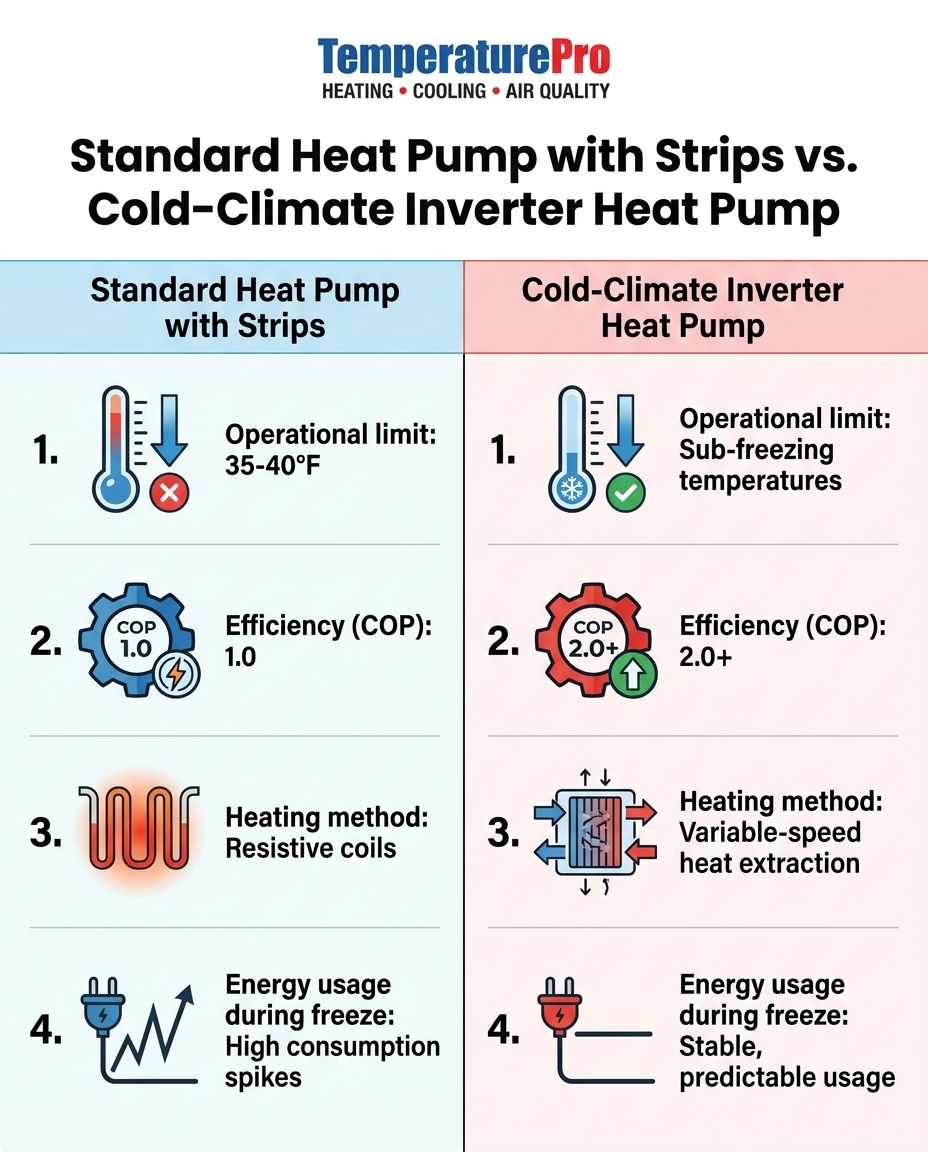
• Operational Threshold — Standard Heat Pump with Strips: Fails at 35-40°F, triggering backup — Cold-Climate Inverter Heat Pump: Thrives in sub-freezing temperatures
• Energy Efficiency — Standard Heat Pump with Strips: COP of 1.0 (1-to-1 energy ratio) — Cold-Climate Inverter Heat Pump: COP of 2.0+ (Moves more heat than it uses)
• Comfort Level — Standard Heat Pump with Strips: Harsh, dry heat blasts; fluctuating temps — Cold-Climate Inverter Heat Pump: Consistent, variable-speed warmth
• Long-Term Value — Standard Heat Pump with Strips: High operational consumption during freezes — Cold-Climate Inverter Heat Pump: Lower, stable, and predictable energy usage
Standard Heat Pump with Strips
This traditional setup relies heavily on resistive coils during deep freezes. Because it operates on an on/off single-speed cycle, it struggles to maintain a consistent temperature when the weather turns harsh. The biggest drawback is the high energy consumption spikes that occur the moment the system switches to auxiliary heat, wiping out any efficiency gains you made during milder weather.
Cold-Climate Inverter Heat Pump
This modern alternative maintains efficient heat extraction well below freezing. By utilizing variable-speed technology, it delivers consistent comfort without the sudden, intense blasts of hot air. More importantly, it provides stable, predictable energy usage throughout the entire winter season, protecting you from unexpected spikes in operational consumption.
Standard Heat Pump with Strips vs. Cold-Climate Inverter Heat Pump
Preparing Proactively: Why Early Fall is the Time to Upgrade
Waiting for the first deep freeze of the year is a reactive strategy that almost always leads to stress. When a sudden polar vortex hits the Gulf South, HVAC companies are flooded with emergency calls from homeowners whose heat strips have failed or whose systems cannot keep up. This reactive approach often leads to rushed decisions and uncomfortable wait times in a freezing house.
September/Early Fall provides the ideal window for system assessments and installations. The weather is transitioning, and your cooling demands are lowering, making it the perfect time to evaluate your heating infrastructure. Addressing your system now gives you the peace of mind that comes from knowing your home is fully prepared for sudden temperature drops.
Handling these issues early prevents winter emergencies. One local customer called us last fall when their heater was not working properly and their AC fan had wiring errors. A technician arrived promptly, repaired the heater, and identified the underlying wiring errors affecting the system. Because they called in the fall, the heater was fully fixed and the overall performance was improved long before the freezing weather arrived.
Exploring flexible financing options now allows time to review choices without the intense pressure of an active heating emergency. You can carefully weigh the benefits of an inverter system, schedule an installation at your convenience, and enter the winter season with total confidence in your home's efficiency.
Making the Right HVAC Choice for Your Baton Rouge Home
Every home's heating needs are unique, and a one-size-fits-all approach simply does not work when it comes to maximizing efficiency. Factors like your home's square footage, insulation levels, ductwork condition, and window placement all play a massive role in determining which system will perform best.
This is why professional load calculations and honest assessments are absolutely critical when considering an upgrade. A proper assessment ensures that your new cold-climate heat pump is perfectly sized for your specific property. An oversized unit will short-cycle and fail to dehumidify, while an undersized unit will run constantly and wear out prematurely. Working with a veteran-owned company means you are getting honest, transparent cost-benefit analysis and reliable, straight-shooting advice for major HVAC investments, without the high-pressure sales jargon.
Once you make the upgrade, regular upkeep ensures that whichever system you choose operates at peak efficiency for years to come. Keeping your system running smoothly with a comprehensive HVAC maintenance plan protects your investment and prevents the gradual loss of efficiency that comes from neglected equipment.
We encourage homeowners to seek transparent, jargon-free technical advice when evaluating their heating infrastructure. By understanding the mechanics of your system and taking proactive steps in the fall, you can enjoy a comfortable, efficient home no matter how far the temperature drops this winter.
Frequently Asked Questions
Why does my heat pump use emergency heat during a freeze? Standard heat pumps lose their ability to efficiently extract heat from the outside air when temperatures drop below roughly 35 degrees Fahrenheit. To prevent your home from getting cold, the system automatically activates the emergency heat strips to make up the difference. This backup method uses resistive electrical heating, which consumes significantly more energy.
Do I need a cold-climate heat pump in Louisiana? While Louisiana winters are generally mild, our region is susceptible to sudden, severe polar vortex drops that completely overwhelm standard heat pumps. A cold-climate heat pump ensures that your system maintains high efficiency and consistent comfort during these deep freezes, preventing massive spikes in your energy consumption when the weather turns harsh.
At what temperature do heat strips turn on? For most traditional heat pumps, the auxiliary heat strips are programmed to turn on when the outdoor temperature falls between 35 and 40 degrees Fahrenheit, or when the indoor temperature drops more than two degrees below your thermostat setting. Modern cold-climate systems, however, are engineered to operate efficiently at much lower temperatures without relying on these strips.
Are cold climate heat pumps worth it in the South? Yes, because they utilize advanced inverter technology that provides variable-speed operation for both heating and cooling. This means they offer superior humidity control and efficiency during our brutal summers, while also protecting you from the massive energy drain of resistive heat strips during unpredictable winter freezes.
Why is my emergency heat running constantly? If your emergency heat is running constantly, it usually means the primary heat pump compressor is either failing to extract enough heat due to extreme cold, or there is a malfunction in the outdoor unit. Running constantly on emergency heat will cause a drastic spike in your energy usage, so it is highly recommended to have a professional inspect the system immediately.
Can a modern inverter heat pump completely replace my need for auxiliary heat strips? In many cases, yes. High-performance inverter heat pumps are designed to maintain their heating capacity even in sub-freezing temperatures, drastically reducing or entirely eliminating the need for resistive backup heat in the Gulf South climate. A professional load calculation can confirm exactly what setup is required for your specific home.
Thank you! Your submission has been received!
Oops! Something went wrong while submitting the form.
Lower autumn sun angles can directly hit your thermostat, causing false high readings that force your AC to run non-stop. See whether relocating the device or adding remote sensors is the best fix.
That alarming odor on the first chilly morning is usually just summer dust burning off your heat strips. Find out how long it should last before you need to worry.
Transitioning your ductless system from summer cooling to fall heating takes more than flipping a switch. Adjusting your louvers and cleaning filters ensures warm air actually reaches the floor.