5 min read
Fall HVAC Troubleshooting: Why Your Heater Smells Like Burning Dust on Startup
Is that burning dust smell normal? Read our home maintenance tips and troubleshooting to see why heating startup odors happen and when to call a professional.


Why Knowing How Commercial HVAC Differs From Home Systems Can Save You Real MoneyHow commercial hvac differs from home systems comes down to five core things: size, placement, complexity, drainage, and maintenance demands.FactorResidential
How commercial hvac differs from home systems comes down to five core things: size, placement, complexity, drainage, and maintenance demands.
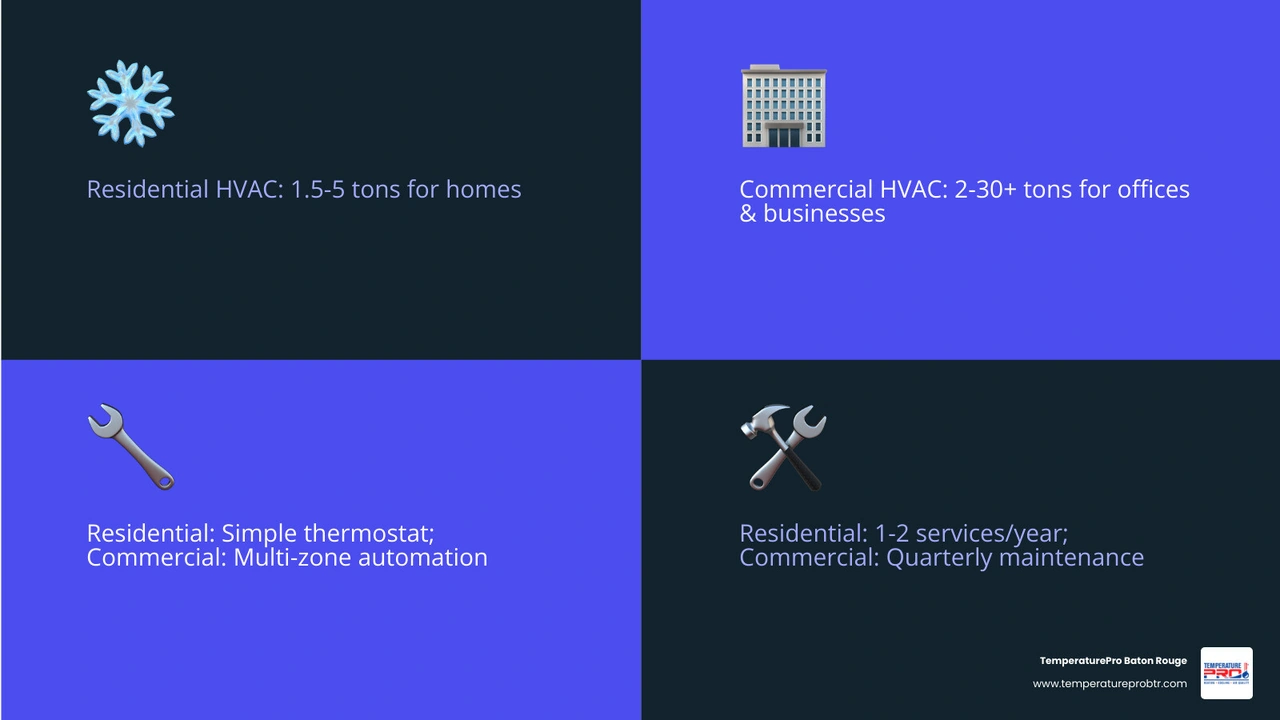
• Cooling capacity — Residential HVAC: 1.5 to 5 tons — Commercial HVAC: 2 to 30+ tons
• Typical placement — Residential HVAC: Ground level, side of home — Commercial HVAC: Rooftop or dedicated mechanical room
• System design — Residential HVAC: Standalone split system — Commercial HVAC: Modular, scalable packaged units
• Drainage — Residential HVAC: Single drain pan — Commercial HVAC: Multiple pipes and pans
• Maintenance frequency — Residential HVAC: 1-2 times per year — Commercial HVAC: Quarterly or monthly
• Controls — Residential HVAC: Single thermostat — Commercial HVAC: Multi-zone, building automation
• Ventilation — Residential HVAC: Natural or minimal mechanical — Commercial HVAC: Mandatory mechanical ventilation
Most people assume a commercial unit is just a bigger home system. It isn't. The two are built around completely different demands — different operating hours, occupancy levels, airflow requirements, and building codes.
A home system runs a few hours at a time to keep one family comfortable. A commercial system in a Baton Rouge office building might run 10 to 16 hours a day, conditioning air for dozens of people, managing heat from lighting and equipment, and meeting strict ventilation standards — all at once.
Getting this distinction wrong leads to real problems: premature equipment failure, code violations, poor comfort, and spiking energy bills.
When we talk about the differences between these two types of systems, we aren't just talking about a bigger box. We are talking about a completely different mechanical philosophy. In a typical home in Zachary or Prairieville, your HVAC system is a "split system." You have an indoor unit (the evaporator) and an outdoor unit (the condenser). They work together to cool a relatively small, static space.
Commercial buildings, however, are dynamic. Think about a retail space in Gonzales or a medical office in Denham Springs. People are constantly walking in and out, doors are opening, and computers are humming. This creates a "cooling load" that is vastly different from a three-bedroom house. Because of this, Commercial HVAC Baton Rouge LA requires a level of engineering that goes far beyond what you’ll find in a residential neighborhood.
One of the most significant ways how commercial hvac differs from home systems is the modular nature of the equipment. If a business grows or the building layout changes, a commercial system can often be expanded by adding modules. In a home, if you add a large addition, you usually have to replace the entire unit or add a separate mini-split because the original system is a standalone "fixed" capacity.
In HVAC, we measure cooling power in "tons." For those of us living in the humid climate of South Louisiana, tonnage is everything. Residential air conditioners are typically available in 1.5 to 5-ton units. A 5-ton unit is usually enough to cool a very large home, but it wouldn't even make a dent in a mid-sized office building.
Average commercial AC sizes range from 2 tons for tiny boutiques to more than 30 tons for large industrial or office spaces. Some massive complexes use chilled water systems that provide hundreds of tons of cooling.
Why the massive jump? It’s all about heat load.
• Occupancy Levels: A home has maybe four or five people. A commercial space might have fifty people in one room, each of whom generates body heat.
• Equipment Density: Servers, copiers, industrial ovens, and even high-intensity lighting all dump heat into the air.
• Square Footage: Commercial ceilings are often much higher, meaning there is more cubic volume of air to treat.
If you take a stroll through a residential street in Walker or Central, you’ll see AC units sitting on concrete pads right next to the house. But if you look at a shopping center or an office complex, the ground is clear. That’s because commercial units are almost always rooftop units (RTUs).
There are several strategic reasons for this:
1. Space-Saving: In commercial real estate, every square foot of ground space is valuable for parking or landscaping. Putting the unit on the roof keeps it out of the way.
2. Noise Reduction: Commercial units are loud. By placing them on the roof, the noise is directed upward and away from the customers and employees inside.
3. Security: Ground-level units are targets for vandalism or copper theft. Rooftop placement keeps the equipment secure.
4. Maintenance Access: Technicians can work on a rooftop unit without walking through a quiet office or a busy restaurant.
Furthermore, these systems are designed to be modular. In a residential setup, the heating and cooling components are often split between the attic and the yard. In a commercial "packaged unit," everything—the compressor, coils, and fans—is housed in one cabinet. This makes Commercial HVAC Services Baton Rouge LA more streamlined for the technician, even if the machinery itself is more complex.
The "brain" of a home system is usually a single thermostat on the wall. You set it to 72°F, and the whole house eventually reaches that temperature. Commercial systems don't work that way. A large building in St. Gabriel or French Settlement might have a server room that needs to be 65°F and a lobby that needs to be 74°F.
To handle this, commercial systems use sophisticated Building Automation Systems (BAS) and zoning.
• Thermostat — Residential System: Simple programmable or smart — Commercial System: Integrated Building Automation (BAS)
• Zoning — Residential System: Basic dampers (if any) — Commercial System: VAV boxes and smart dampers
• Evaporator — Residential System: Finned-tube — Commercial System: Spine fin or shell-and-tube
• Compressor — Residential System: Piston or scroll — Commercial System: Centrifugal or screw-type
• Air Handling — Residential System: Simple blower fan — Commercial System: Large Air Handling Units (AHUs)
Understanding the Commercial HVAC Maintenance Importance is vital here because if one of these complex control components fails, you don't just lose cooling in one room—you could potentially throw the entire building’s pressure and temperature balance out of whack.
Living in Louisiana means dealing with humidity. Both systems act as giant dehumidifiers, pulling moisture out of the air as they cool it. However, the volume of water produced by a 30-ton commercial unit is massive compared to a 3-ton home unit.
Residential systems typically have a single drain pan and a small PVC pipe that leads outside. If it clogs, you might get a wet spot on your ceiling. In a commercial setting, a failed drainage system can cause thousands of gallons of water to damage expensive inventory or electronic equipment.
Because of this, commercial drainage is much more elaborate. It involves multiple pipes and pans, overflow sensors, and often specialized pumps to ensure that condensate is moved away from the structure effectively. Moisture management is a primary reason why commercial systems require more frequent inspections.
The level of precision in a commercial system is truly impressive. Using Variable Air Volume (VAV) boxes and smart dampers, the system can redirect airflow on the fly.
Imagine a conference room in a Baton Rouge office. At 9:00 AM, it’s empty. At 10:00 AM, twenty people walk in for a meeting. A commercial system uses sensors to detect the rise in CO2 or temperature and automatically opens dampers to pump more cool air into that specific room without freezing out the person in the office next door. This level of "precise conditioning" is something residential systems simply aren't built to do.
In a home, "ventilation" usually means opening a window or turning on a bathroom fan. In a commercial building, especially in places like Commercial HVAC Central LA, the building is often "sealed." This means the HVAC system is the only source of fresh air for the occupants.
Commercial systems must adhere to strict ASHRAE standards, which dictate how much outdoor air must be brought in per occupant. This is where "economizers" come in—they are components that pull in fresh outdoor air when the weather is nice to save energy and improve air quality.
Our teams frequently visit businesses for Commercial HVAC Prairieville LA to ensure these ventilation systems are functioning. If they aren't, the air inside can become "stale," leading to "Sick Building Syndrome," where employees feel fatigued or develop headaches due to poor air exchange.
Why is this so much more critical for businesses?
• Safety Codes: Many commercial spaces, like restaurants or auto shops, produce fumes or smoke that must be mechanically exhausted.
• Occupancy Density: More people means more CO2. Without proper air exchange, oxygen levels can actually dip slightly, affecting productivity.
• Pollutant Removal: Commercial systems often use much higher-rated filters (like HEPA or high-MERV filters) to pull pollutants out of the air, which is essential in medical or laboratory environments.
Because commercial systems run harder and longer, they wear out faster if neglected. While we recommend a home system get a "check-up" twice a year, a commercial system usually needs quarterly service.
We look at performance trends and "IEER" (Integrated Energy Efficiency Ratio) ratings. Unlike residential SEER ratings, which measure efficiency at a single peak, IEER looks at how the system performs at part-load. Since commercial buildings are rarely at 100% capacity, part-load efficiency is where the real energy savings are found.
Regular maintenance helps us catch small issues—like a worn belt or a slightly low refrigerant charge—before they turn into a total system shutdown that forces a business to close for the day.
We get this question a lot, especially from people opening small boutiques or offices in converted homes in places like Denham Springs. The short answer is: almost never.
Residential units are not built for the "duty cycle" of a business. They are designed to cycle on and off. If you put a residential unit in a space with high foot traffic and commercial lighting, it will run constantly, overheat, and likely fail within a few years. Furthermore, residential units rarely meet the mechanical ventilation codes required for a commercial certificate of occupancy. "Light commercial" units are a better middle ground—they are built with the durability of a commercial system but sized for smaller spaces.
As we mentioned earlier, it's about space, sound, and security. But there's also an engineering reason: ductwork efficiency. When the unit is on the roof, the ductwork can often be run more vertically and directly into the various zones of the building. This reduces the "static pressure" the fans have to overcome, making the whole system more energy-efficient. It also protects the unit from the "mower deck" damage and dirt accumulation that happens at ground level.
A well-maintained residential system in Baton Rouge usually lasts 10 to 15 years. You might think a commercial system, being "heavy-duty," would last longer. Surprisingly, the lifespan is often similar or even slightly shorter—around 10 to 12 years—simply because they are used so much more intensely.
Think of it like a personal car versus a delivery truck. The delivery truck is built tougher, but because it’s driven 12 hours a day, it might need replacement sooner than a car that only goes to the grocery store and back. Proactive care is the only way to push a commercial unit toward that 15-year mark.
At the end of the day, the goal of any HVAC system is comfort. But the path to getting there is very different depending on whether you’re sitting in your living room in Zachary or managing a retail floor in Gonzales.
Understanding how commercial hvac differs from home systems is the first step in protecting your business investment. Because these systems are so complex, they require a specialized touch. You wouldn't ask a bicycle mechanic to fix a jet engine; similarly, commercial systems need technicians who understand the nuances of modular design, building automation, and high-capacity drainage.
At TemperaturePro Baton Rouge, we are family and veteran-owned, and we treat every local business like our own. Whether you need a complex rooftop installation or a customized maintenance agreement to keep your office running smoothly, we have the expertise to get it done right the first time.
If you're looking for a partner to manage your business's climate, explore our Commercial services today. We provide 24/7 support across the entire Baton Rouge area, ensuring that your doors stay open and your employees stay cool—no matter how high the Louisiana humidity climbs.
Go With Experience