5 min read
Fall HVAC Troubleshooting: Why Your Heater Smells Like Burning Dust on Startup
Is that burning dust smell normal? Read our home maintenance tips and troubleshooting to see why heating startup odors happen and when to call a professional.


Why Commercial HVAC Basics for Business Owners Matter More Than You ThinkUnderstanding commercial HVAC basics for business owners is one of the most important — and most overlooked — parts of running a successful business. Your heating, ven
Understanding commercial HVAC basics for business owners is one of the most important — and most overlooked — parts of running a successful business. Your heating, ventilation, and air conditioning system quietly controls the comfort of everyone inside your building. When it works, nobody notices. When it fails, everyone does.
Here is a quick overview of what every business owner should know:
• What it is: A commercial HVAC system controls temperature, humidity, and indoor air quality in business spaces like offices, retail stores, restaurants, and warehouses.
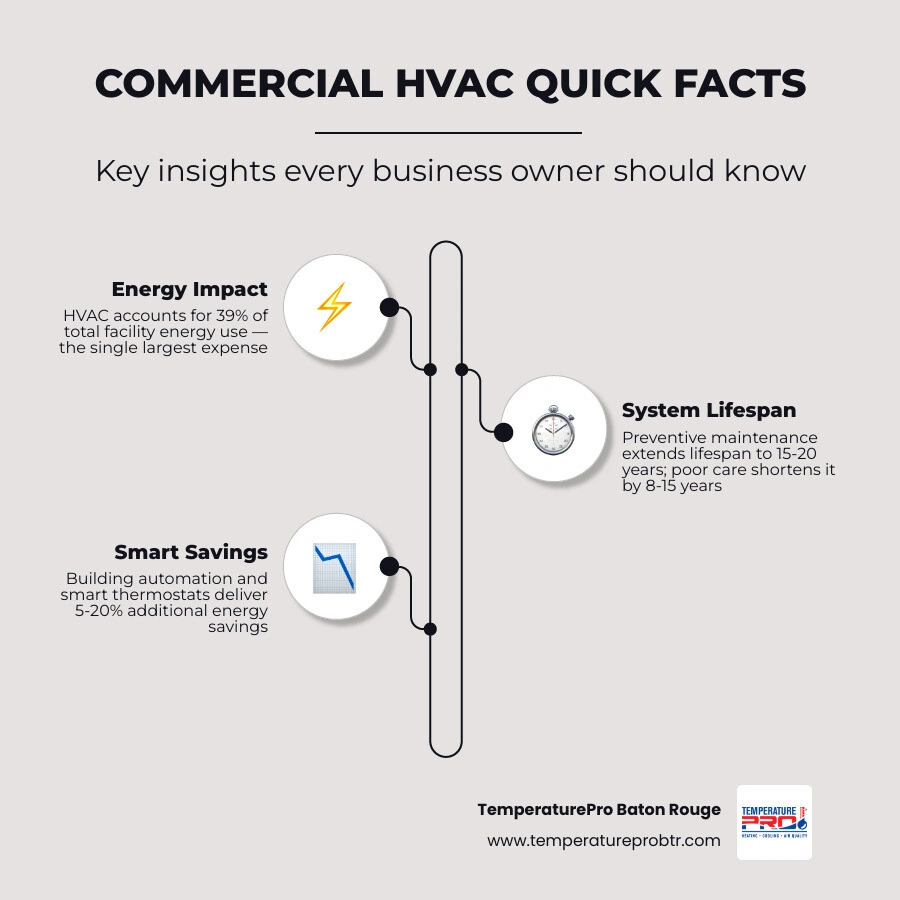
• Why it matters: HVAC accounts for roughly 39% of a facility's total energy use — making it your single largest energy expense.
• Key system types: Rooftop units (RTUs), split systems, VRF systems, chillers, and packaged units — each suited to different building sizes and needs.
• Maintenance reality: Preventive maintenance can cut energy costs by 10–40% and extend system life to 15–20 years. Poor maintenance can shorten that lifespan by 8–15 years.
• Warning signs: Rising utility bills, unusual noises, short cycling, and inconsistent temperatures are all red flags.
• Smart controls: Building automation and smart thermostats can save an additional 5–20% on energy costs through temperature setbacks and demand-based ventilation.
Whether you own a small café in Baton Rouge or manage a large commercial facility across the greater Louisiana area, your HVAC system is a core business asset — not just a background appliance. This guide walks you through everything you need to know to make confident, informed decisions about your commercial heating and cooling system.

When we talk about commercial hvac basics for business owners, the first thing to understand is the sheer scale and complexity involved. Unlike a residential unit that might cool a three-bedroom home, a commercial system has to manage massive square footage, high occupancy levels, and varying heat loads from computers, machinery, and lighting.
In our experience serving businesses in the Baton Rouge area, we’ve seen how these systems act as the building's respiratory and circulatory systems. They don't just "blow cold air"; they manage the entire environment to ensure safety, comfort, and productivity. Because these systems are more complex, they require specialized Commercial HVAC Baton Rouge LA expertise to install and maintain properly.
• Size/Capacity — Residential HVAC: Usually 1.5 to 5 tons — Commercial HVAC: Can exceed 50 tons
• Placement — Residential HVAC: Ground level or side of house — Commercial HVAC: Usually rooftop or dedicated mechanical rooms
• Complexity — Residential HVAC: Simple standalone units — Commercial HVAC: Complex, multi-zone, integrated systems
• Drainage — Residential HVAC: Single condensate pan/line — Commercial HVAC: Complex multi-line drainage systems
• Ventilation — Residential HVAC: Natural or simple mechanical — Commercial HVAC: Stricter ASHRAE standards for fresh air intake
One of the most significant differences is modularity. Commercial systems are often designed in modules. If your business grows, we can often add modules to increase capacity without replacing the entire setup. Furthermore, these units are built for extreme durability. While a residential unit might run for a few hours a day, a commercial system in a data center or a 24-hour retail outlet in Zachary might run non-stop.
Proper Commercial Properties HVAC Installation also accounts for specific building codes and OSHA regulations that simply don't apply to homes. This includes specific exhaust requirements for kitchens or chemical-sensitive environments.
In the humid climate of Louisiana, moisture control is a vital part of commercial hvac basics for business owners. High humidity doesn't just feel "sticky"—it can actually lower employee cognitive function and decision-making abilities. Research shows that maintaining humidity between 40% and 60% is the "sweet spot" for human health and building integrity.
Our Commercial Heating and Cooling Baton Rouge LA services prioritize indoor air quality (IAQ) by adhering to ASHRAE 62.1 standards. This ensures that enough fresh outdoor air is being circulated to prevent "Sick Building Syndrome," which can lead to increased employee absenteeism and reduced morale.
Choosing the right system depends on your building's architecture and your specific business needs. Here are the heavy hitters in the industry:
1. Rooftop Units (RTUs): These are the "packaged" powerhouses you see on top of flat-roofed buildings like big-box stores. Everything—the compressor, coils, and fans—is in one weather-resistant box.
2. Split Systems: Similar to residential setups but larger. These have an indoor unit (air handler) and an outdoor unit (compressor). They are great for smaller offices or retail shops in Commercial HVAC Zachary LA.
3. Chillers: These use water instead of air to move heat. They are typically found in very large facilities, hospitals, or university campuses.
4. Boilers: While we focus heavily on cooling in Louisiana, many older commercial buildings still rely on boilers for efficient hydronic heating during our occasional cold snaps.
Variable Refrigerant Flow (VRF) systems are often called the "Teslas" of the HVAC world. They are incredibly sophisticated because they can provide simultaneous heating and cooling to different parts of the building.
Imagine your accounting department is freezing because they are in the shade, but your sales floor is sweltering due to large windows and high foot traffic. A VRF system can take the heat removed from the sales floor and "pump" it into the accounting office. This heat recovery technology makes VRF systems up to 30% more efficient than traditional ducted systems.
Packaged units are the ultimate space-savers. Since they sit on the roof, they don't take up any valuable indoor square footage. They are also easier for us to service because all the components are in one place, which minimizes disruption to your daily operations.
Split systems, on the other hand, might be necessary if your building doesn't have a flat roof or the structural integrity to support a heavy RTU. When planning a Commercial Furnace Installation Guide Prairieville LA, we look at these configuration options to ensure you get the most efficient heat distribution for your layout.
Energy efficiency isn't just a "green" goal; it’s a financial one. Since HVAC accounts for nearly 40% of your energy bill, even small improvements can lead to massive savings. Modern systems are rated using SEER2 standards, and investing in high-efficiency equipment can reduce your operating costs by 20–40%.
Beyond temperature, your system is your first line of defense against pollutants. We recommend using MERV 13 filters for most commercial settings. These are dense enough to catch bacteria and smoke particles without putting too much strain on your system's blower motor.
For businesses in Denham Springs, our Commercial Heating and Cooling Denham Springs LA experts also suggest Demand Control Ventilation (DCV). This technology uses CO2 sensors to monitor how many people are in a room. If a conference room is empty, the system scales back fresh air intake; if it’s full, it ramps up. This prevents you from paying to condition air that nobody is breathing.
The days of manual "on/off" switches are over. Direct Digital Controls (DDC) and Building Automation Systems (BAS) allow you to manage your entire facility from a smartphone or tablet.
• Temperature Setbacks: Automatically adjusting the temperature by just a few degrees when the building is empty can save 5–20% on energy.
• Remote Monitoring: We can often spot a problem via your smart controls before you even feel the temperature change, allowing for proactive repairs.
• Zoning: Precision zoning ensures you aren't cooling a warehouse to the same level as a server room.
If there is one thing we want you to take away from this guide on commercial hvac basics for business owners, it’s this: Preventive maintenance is always cheaper than reactive repair.
A well-maintained system can last up to 20 years. A neglected one might fail in 7. Something as small as 0.042 inches of dirt on a condensing coil can drop your system's efficiency by 21%. We provide comprehensive Commercial HVAC Maintenance Importance checklists that include coil cleaning, electrical tightening, and refrigerant level checks to keep your overhead low.
Heating might not be on your mind in July, but a failing furnace can be a major liability in the winter. If your heating system is over 15 years old, it’s likely time to consult a Commercial Furnace Replacement Guide Prairieville LA.
Signs that it's time to replace include:
• Your repair costs are reaching 50% of the value of a new system.
• Your energy bills have spiked despite normal usage.
• You can no longer find replacement parts for an outdated model.
Keep an eye (and ear) out for these symptoms of a struggling system:
• Short Cycling: The unit turns on and off rapidly. This puts immense wear on the compressor.
• Unusual Noises: Banging, squealing, or grinding often indicates a loose belt or a failing motor.
• Refrigerant Leaks: If your system is struggling to reach the set temperature, you might have a leak. This isn't just an efficiency issue; it's an environmental and regulatory one.
• Poor Airflow: This could be a sign of clogged filters or ductwork issues.
In a standard office environment, we recommend inspecting filters monthly and replacing them every 1 to 3 months. However, if you run a high-traffic retail store or a restaurant in Baton Rouge, you may need monthly changes to account for the extra dust, grease, and outdoor pollutants.
Economizers are sometimes called the "best-kept secret" of commercial HVAC. They pull in cool outdoor air when the weather permits, providing "free cooling" without running the compressor. This significantly reduces energy consumption during our milder Louisiana spring and fall days.
Buying a unit involves a larger upfront capital expenditure but offers long-term ROI and full control over the asset. Renting or leasing can provide predictable monthly costs that often include maintenance and repairs. Most business owners prefer to buy their systems to take advantage of tax incentives and long-term depreciation, but the best choice depends on your specific cash flow and business model.
At TemperaturePro Baton Rouge, we understand that your business is your livelihood. As a family and veteran-owned company, we treat your facility with the same care we’d give our own. From 24/7 emergency support to precision installations across Prairieville, Gonzales, and Central, we are here to ensure your HVAC system is a source of comfort, not a source of stress.
Don't wait for a total system failure to think about your air conditioning. Whether you need a routine tune-up or a full system redesign, Contact our team for expert commercial HVAC solutions today. We’ll help you master the basics and keep your business running cool.
Go With Experience